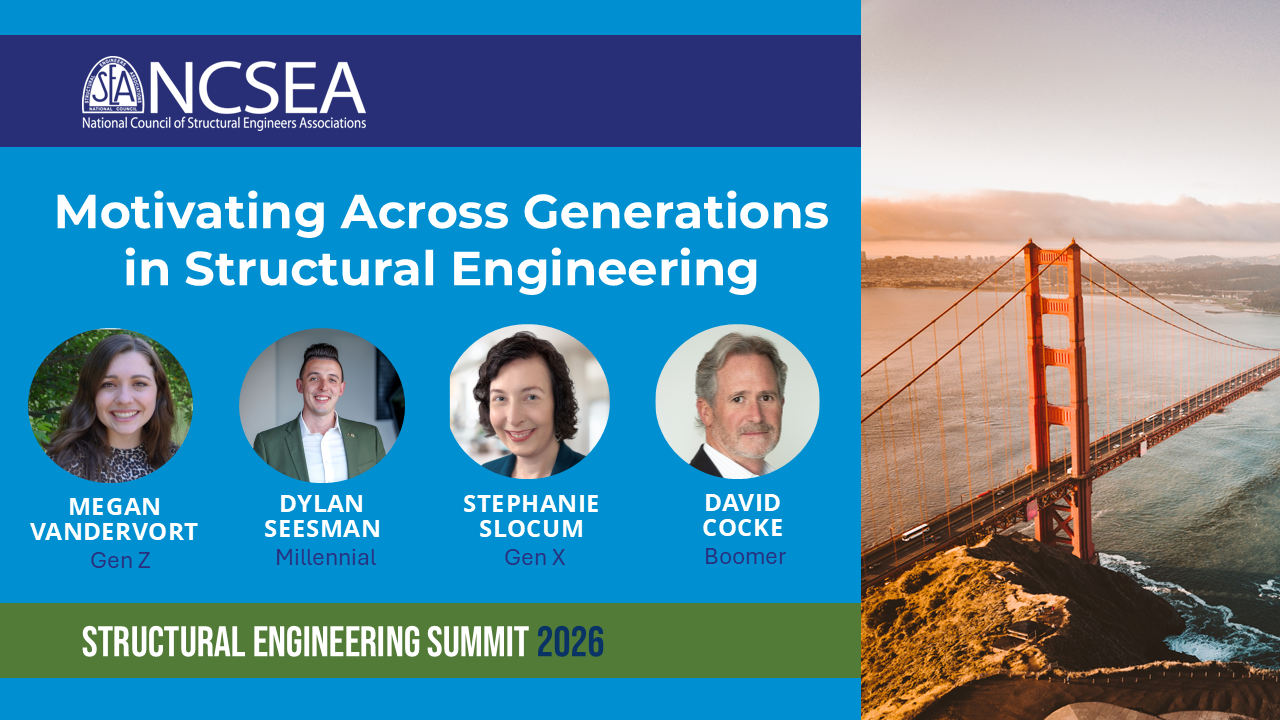
Motivating Across Generations in Structural Engineering
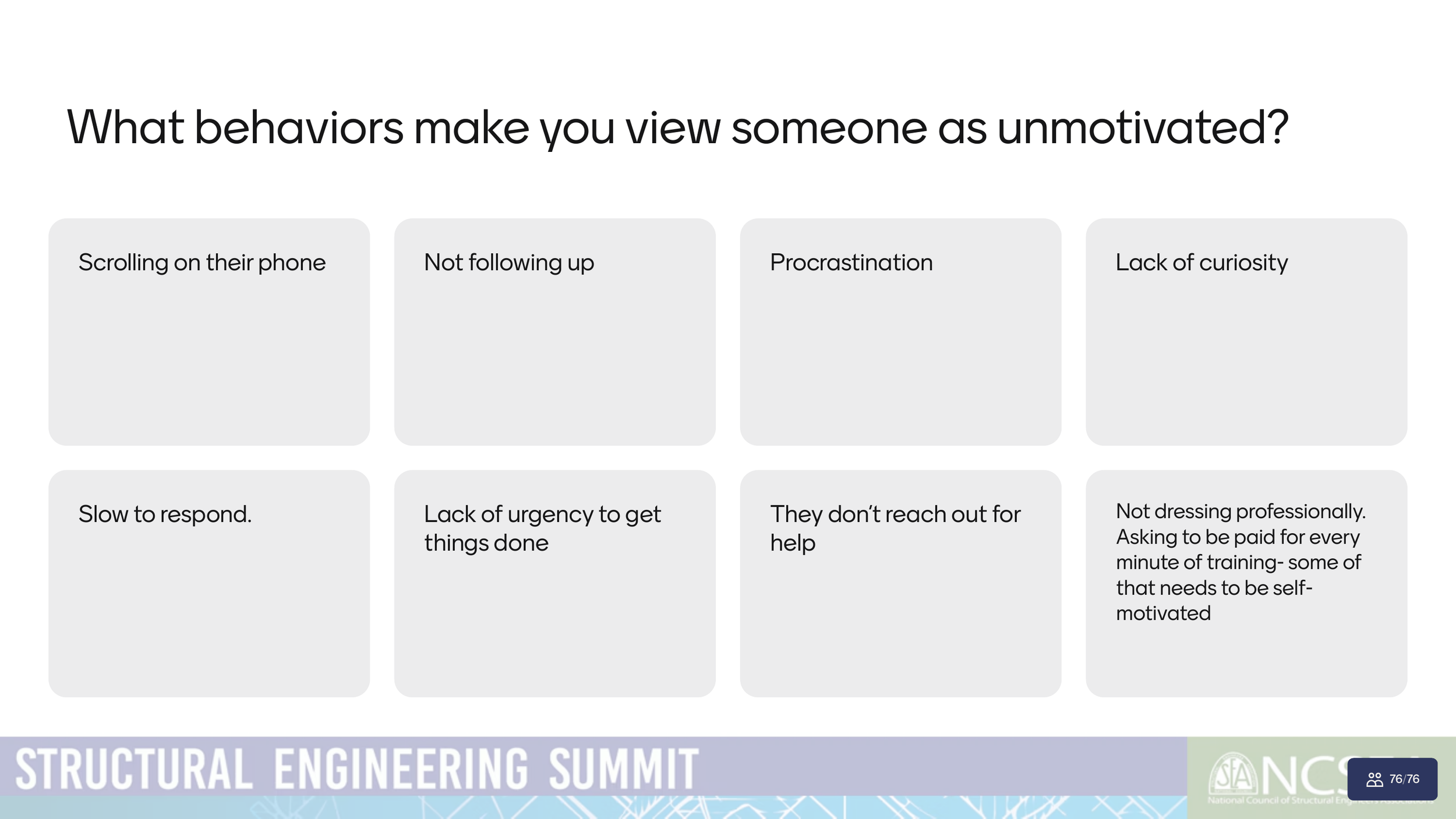
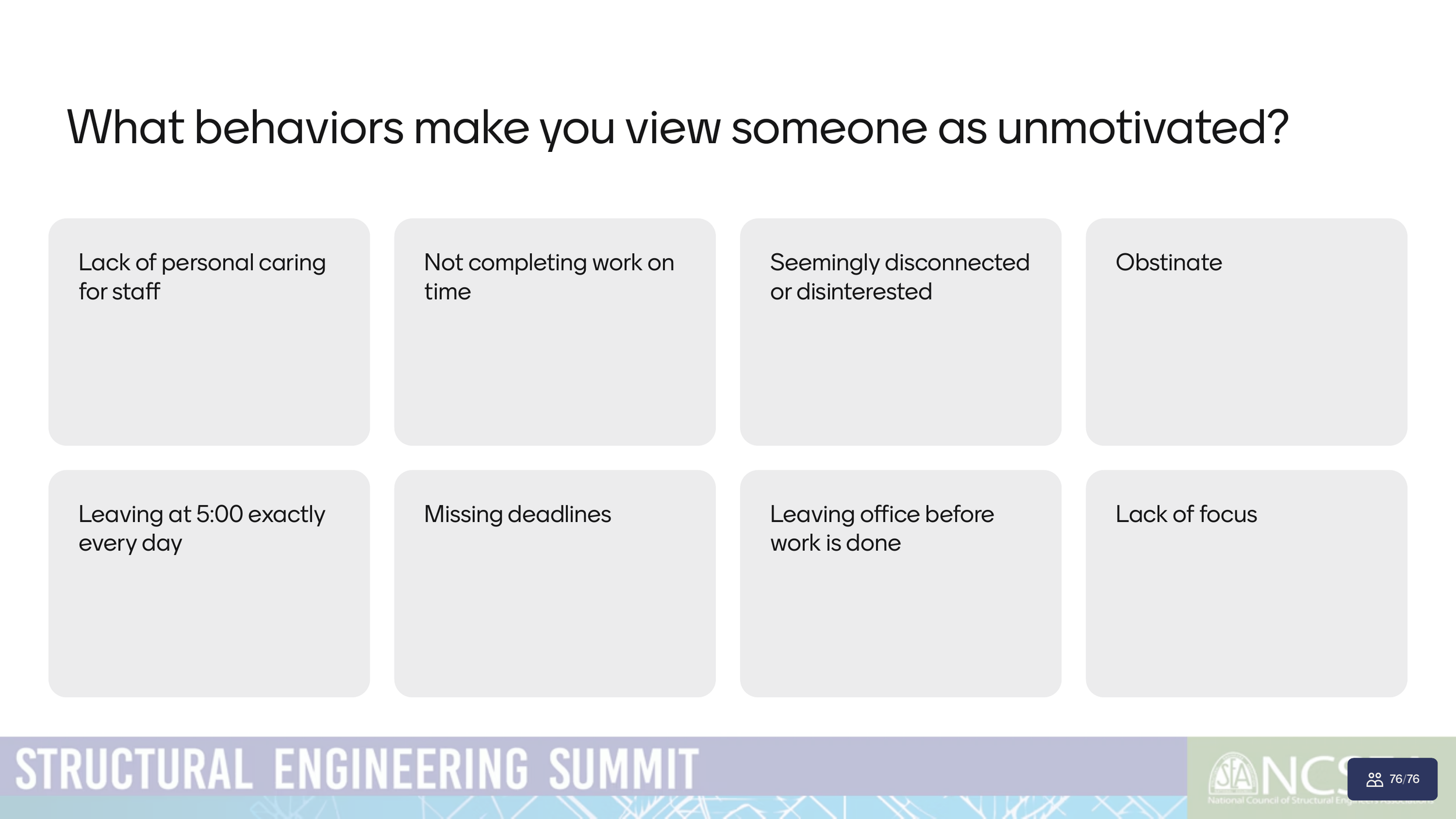
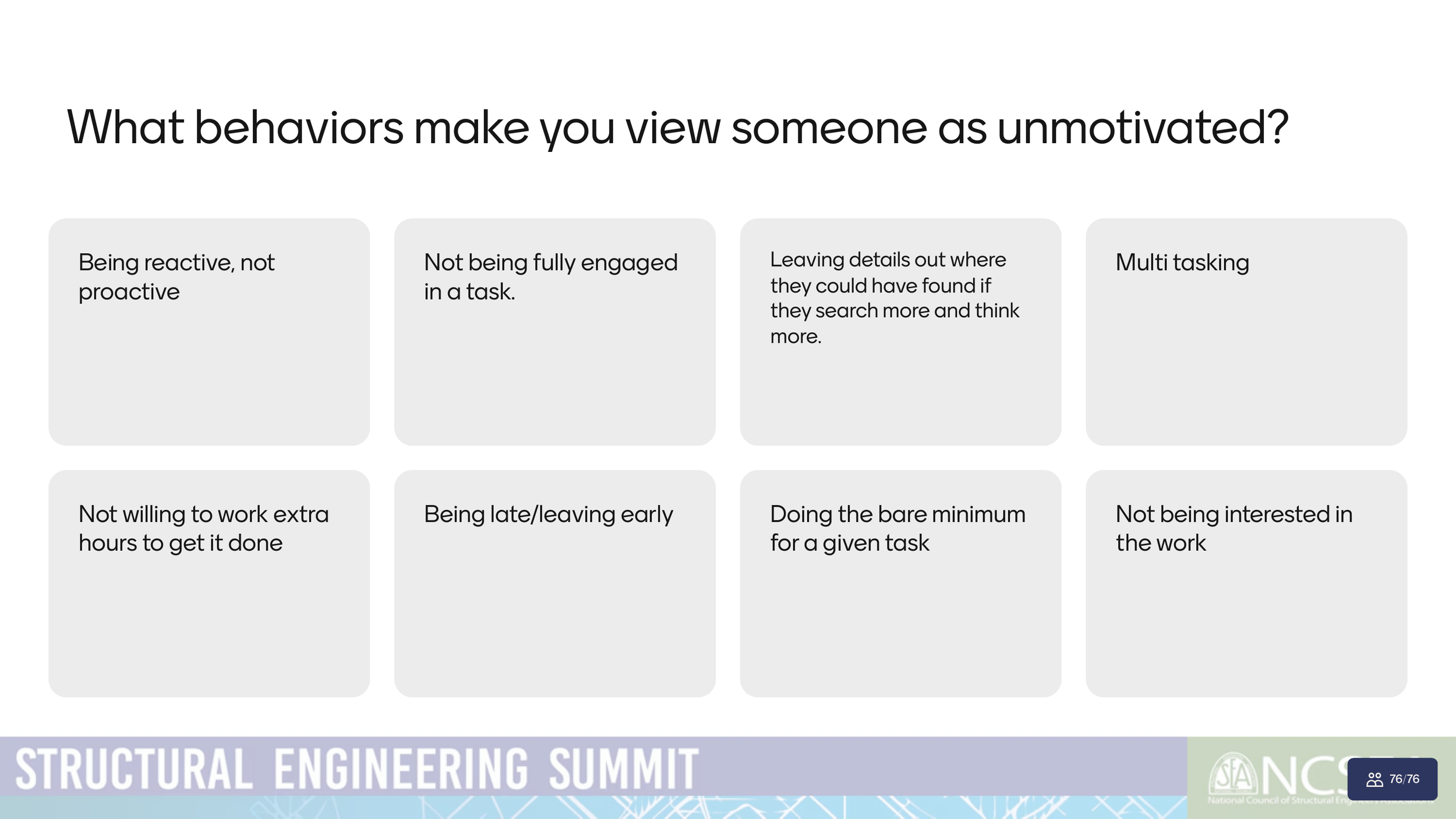
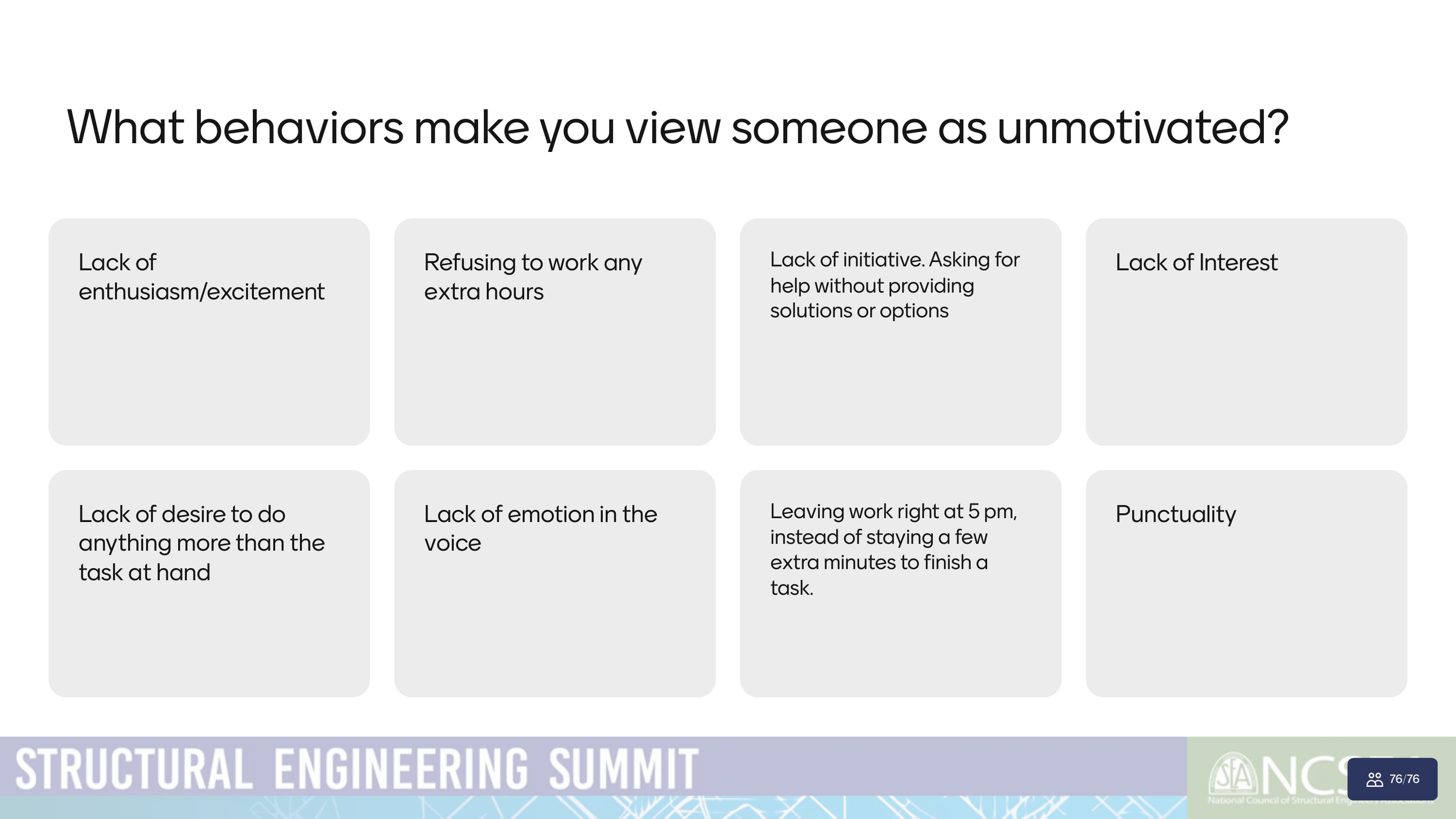
Slides from the session with mentimeter answers are available HERE.
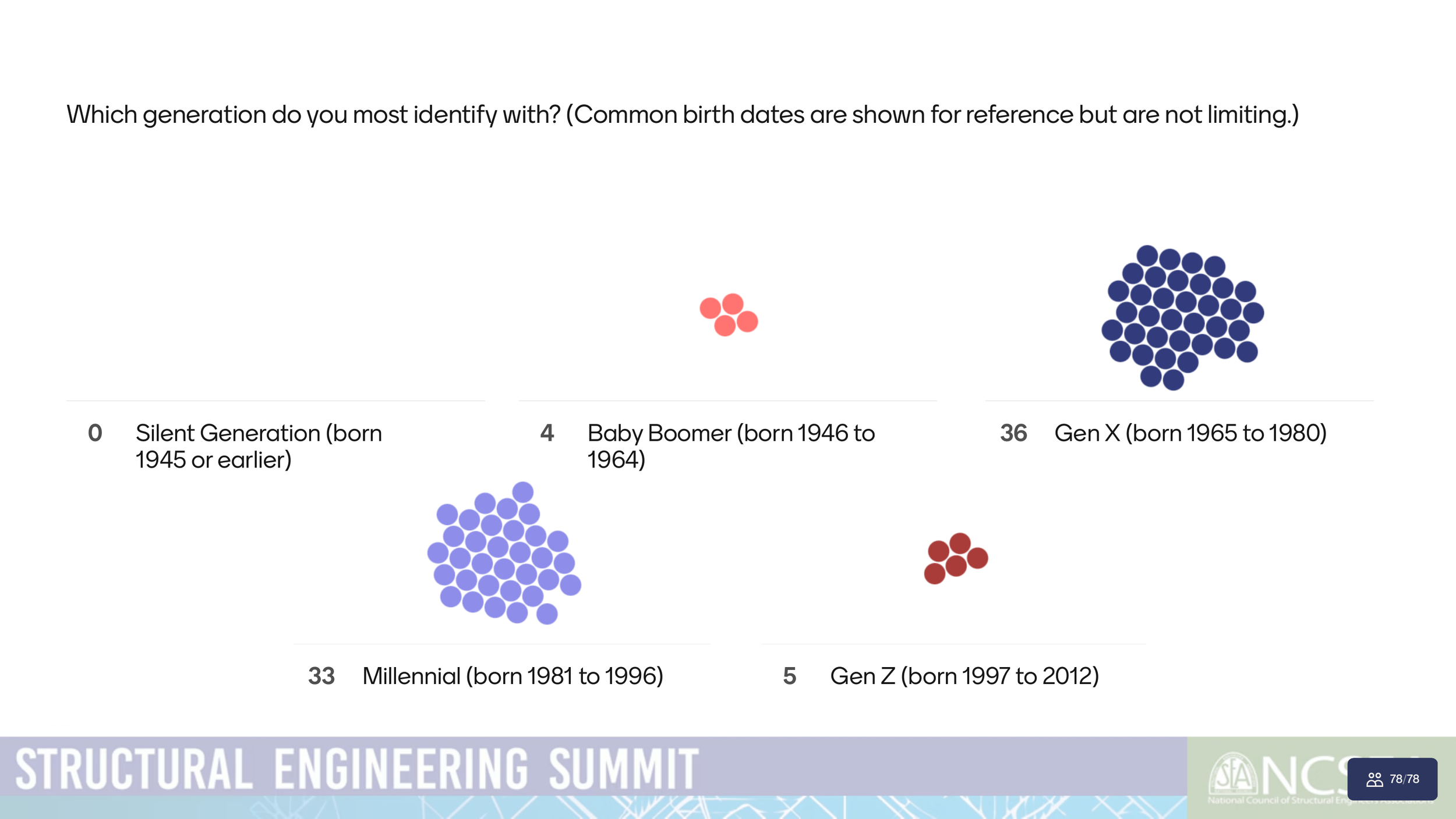
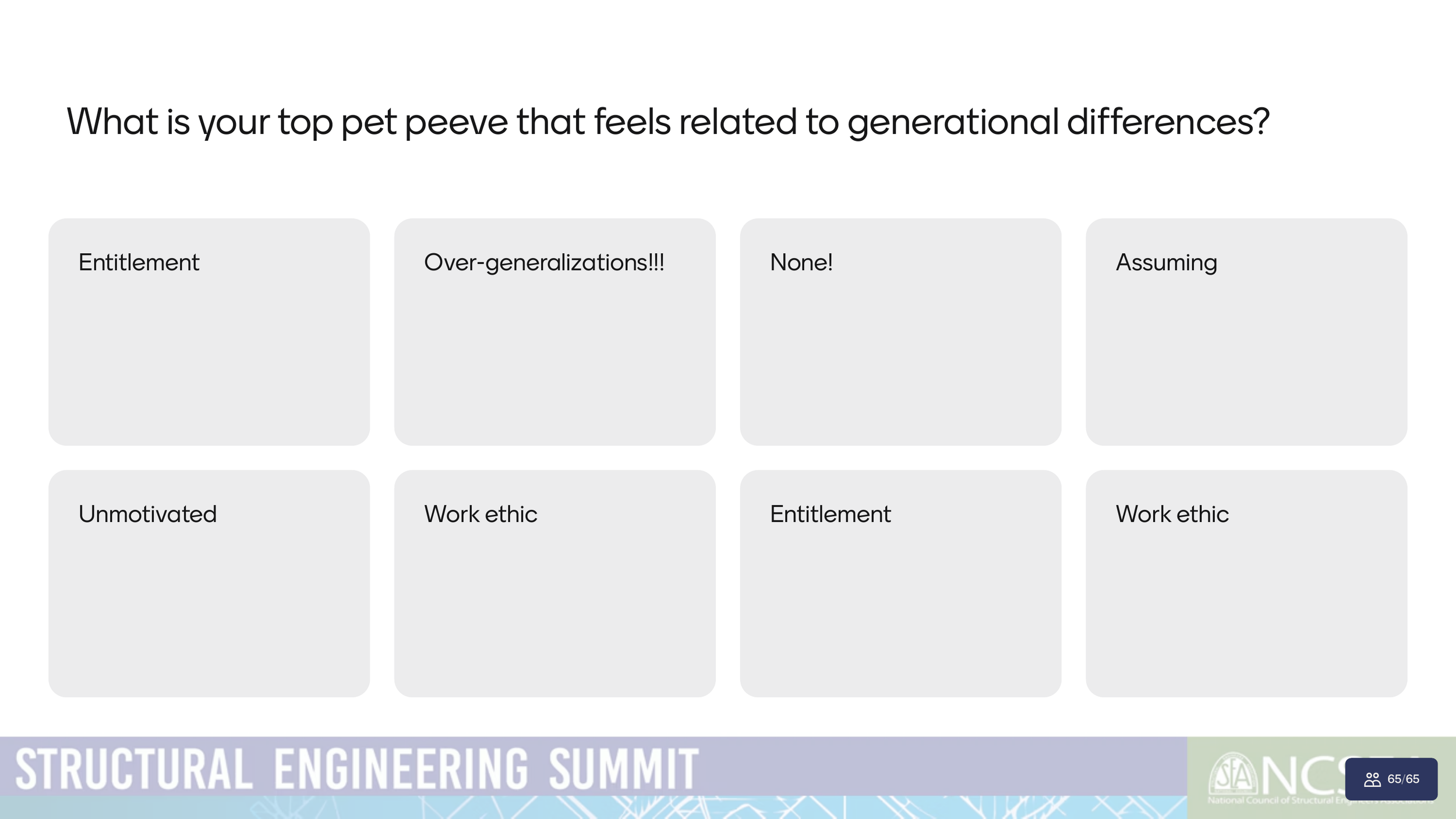
Data from the NCSEA SUMMIT’S 10.29.26 session
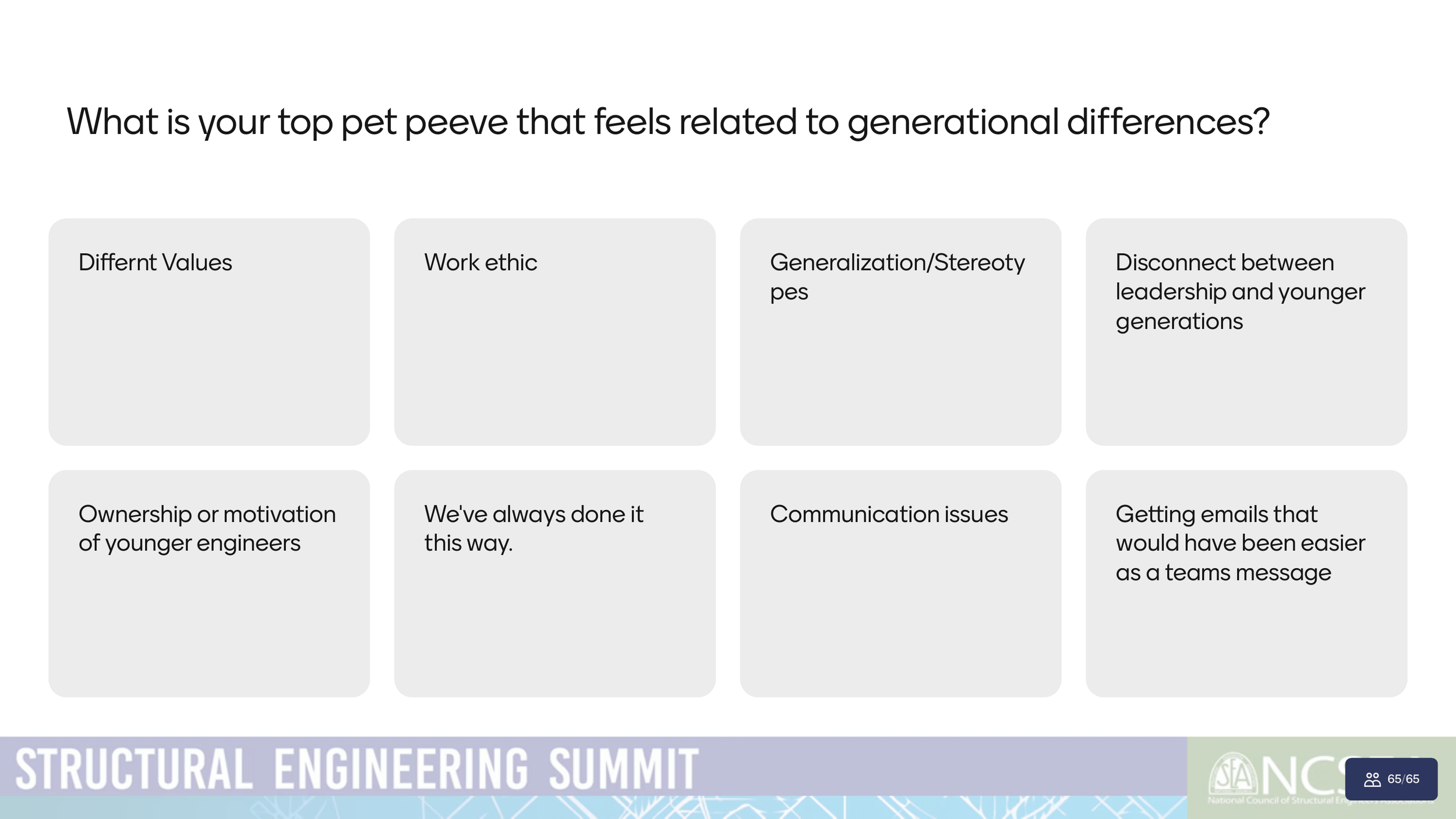
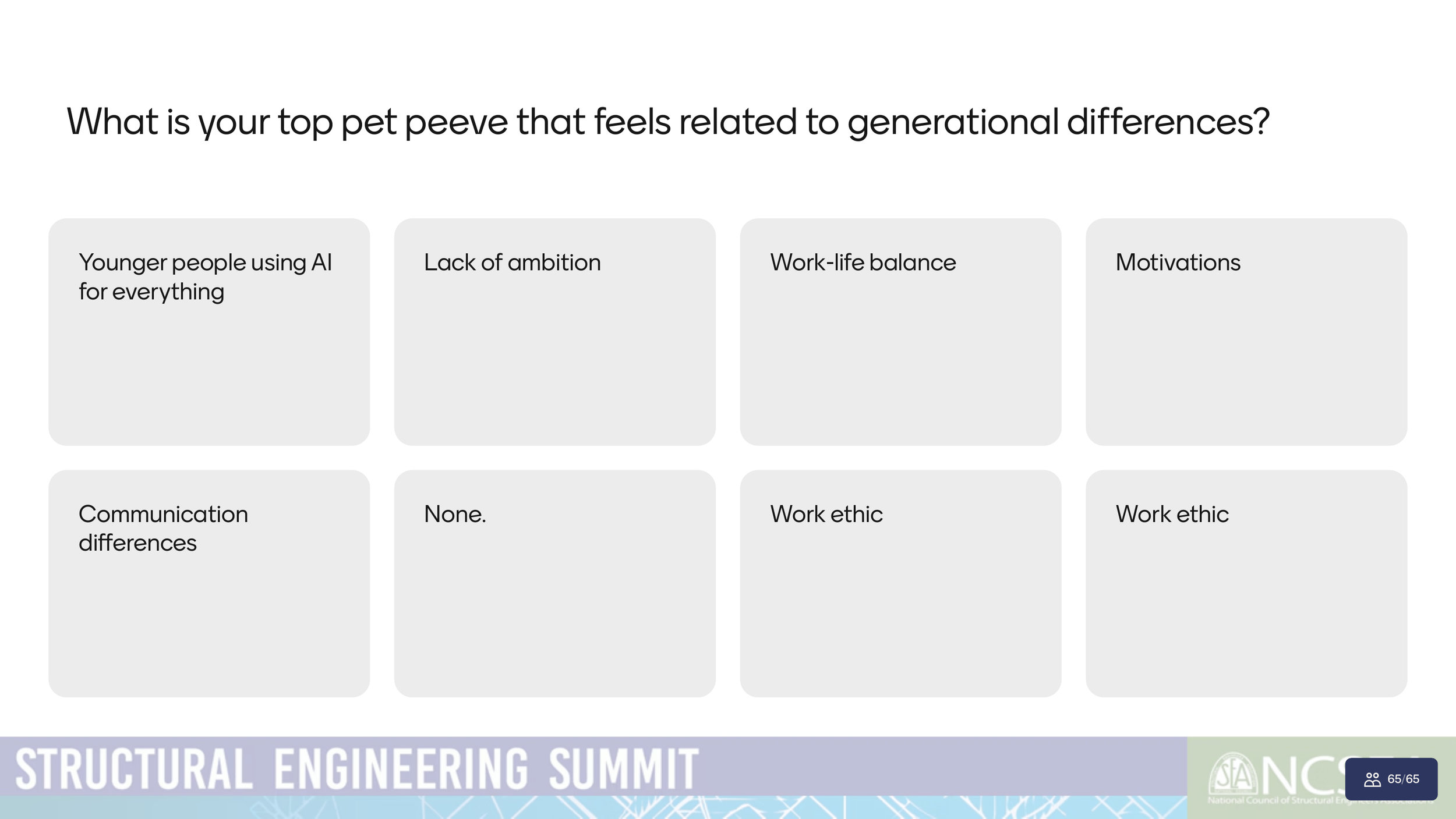
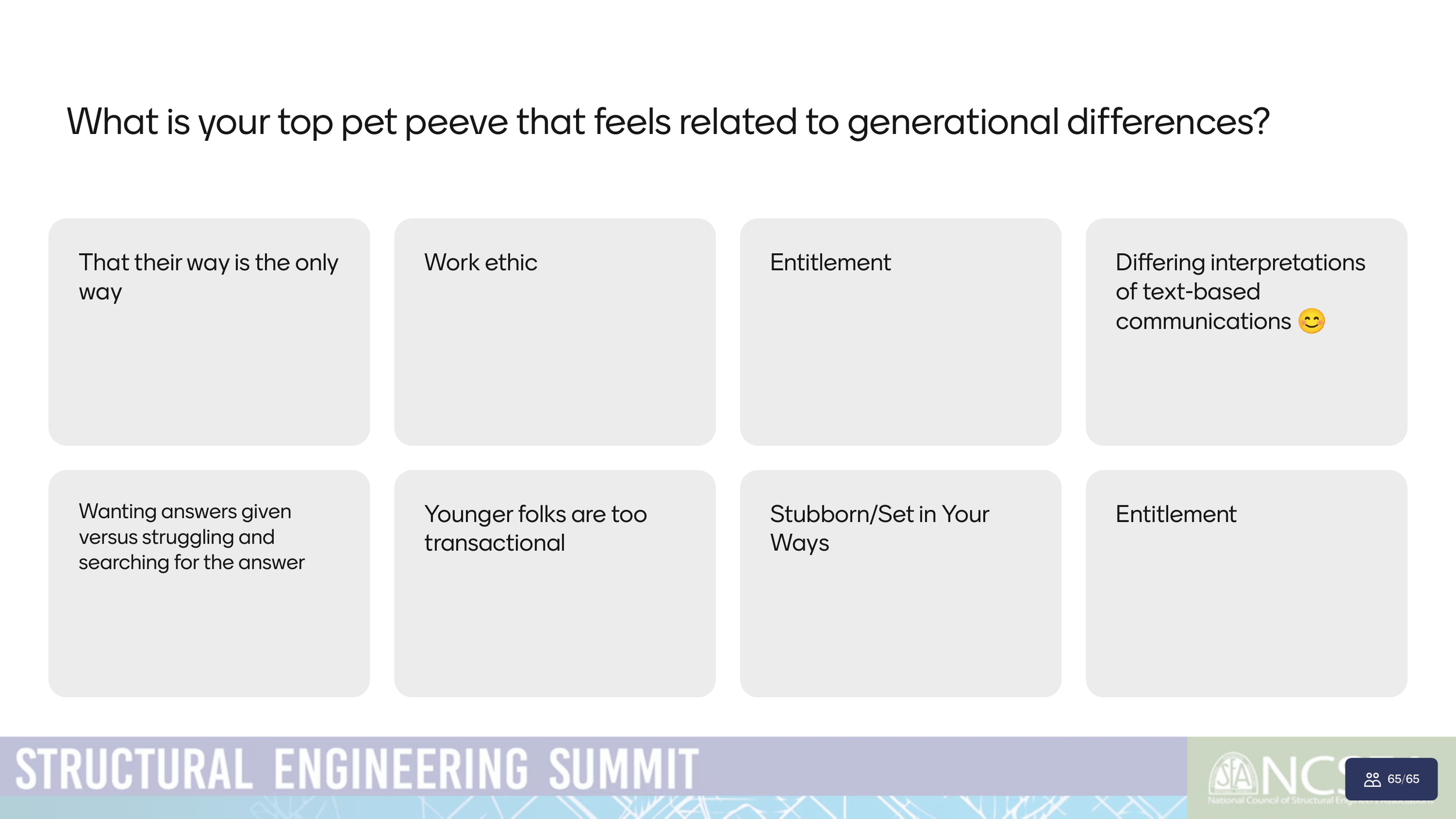
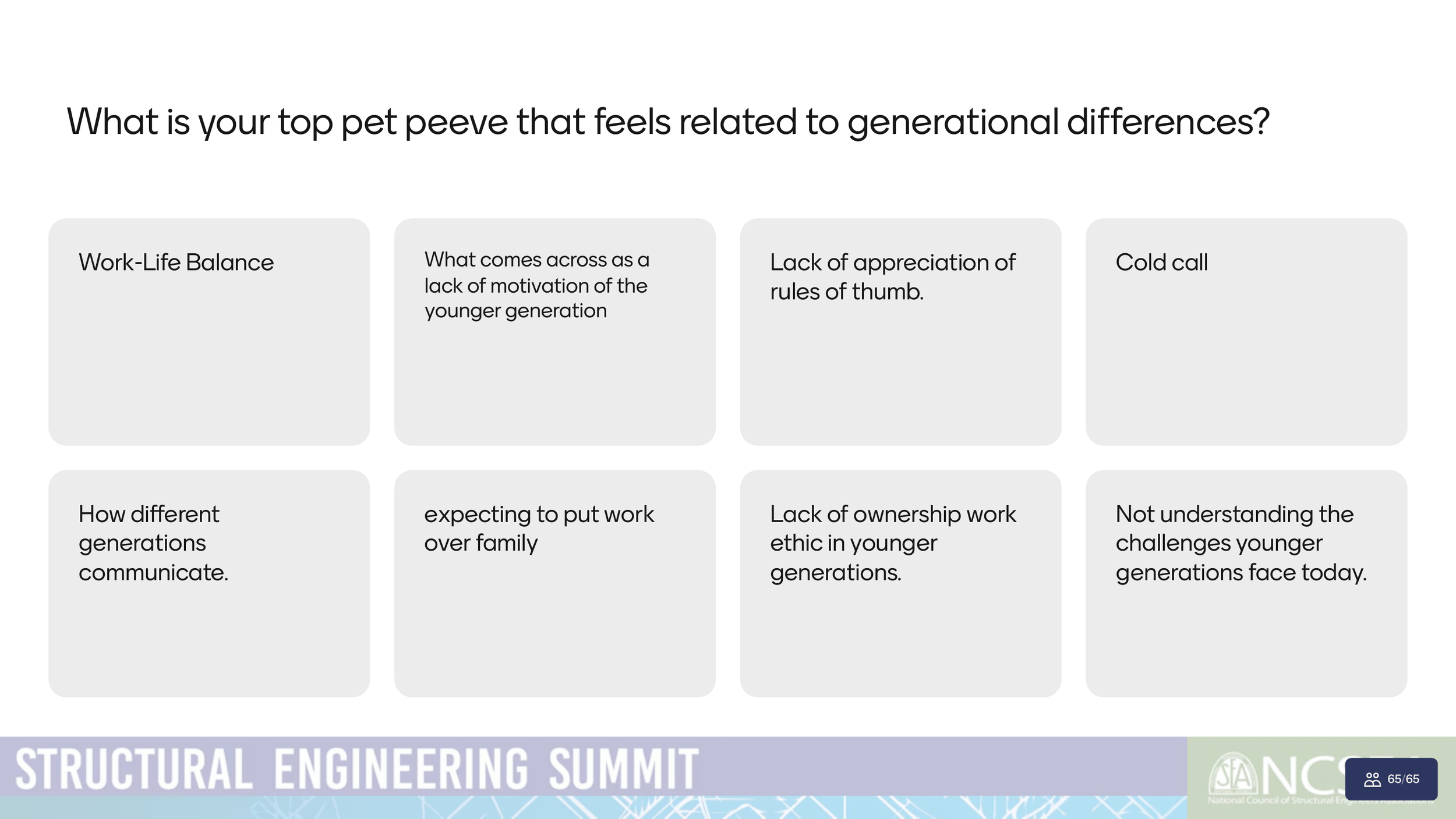
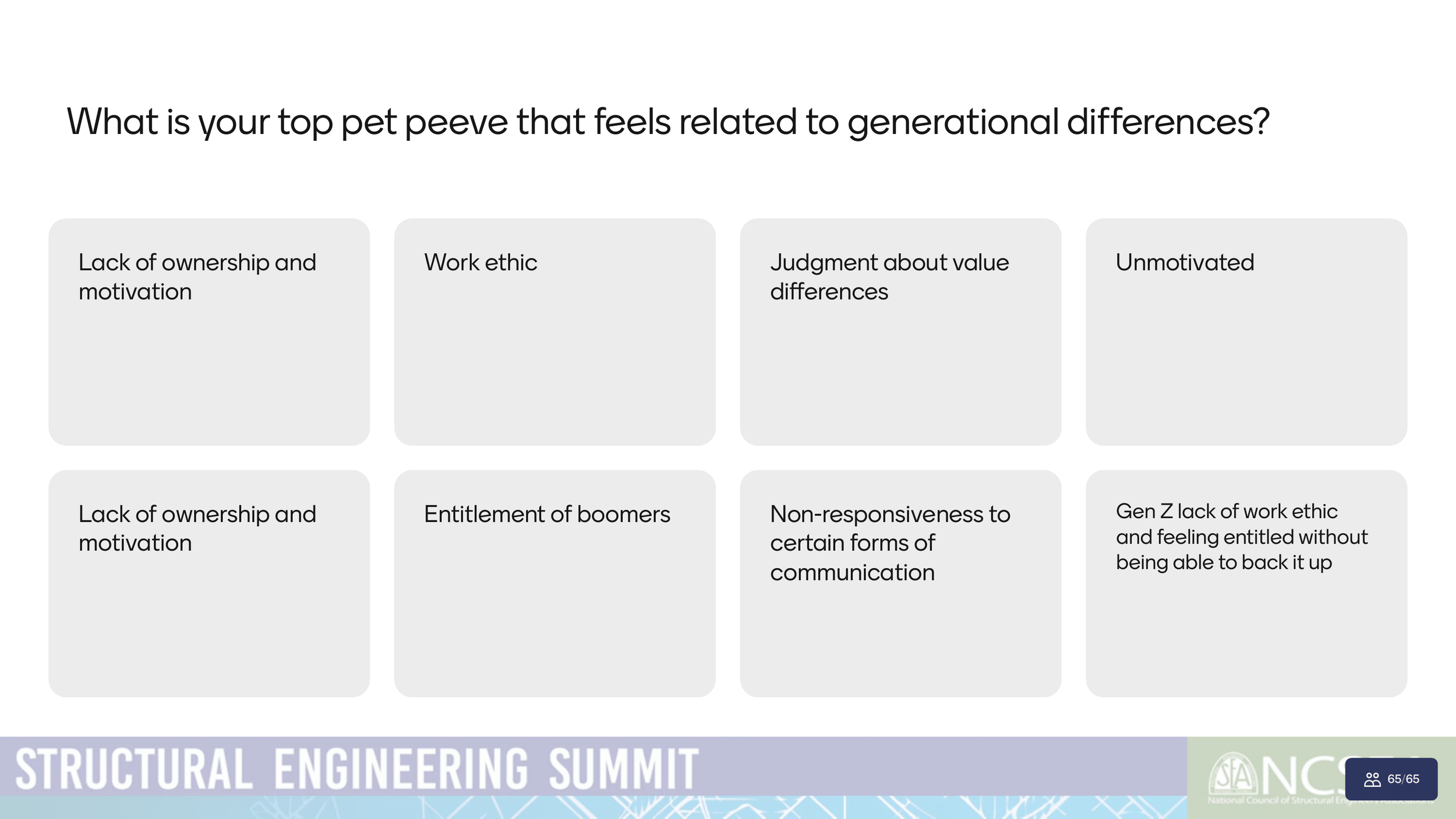
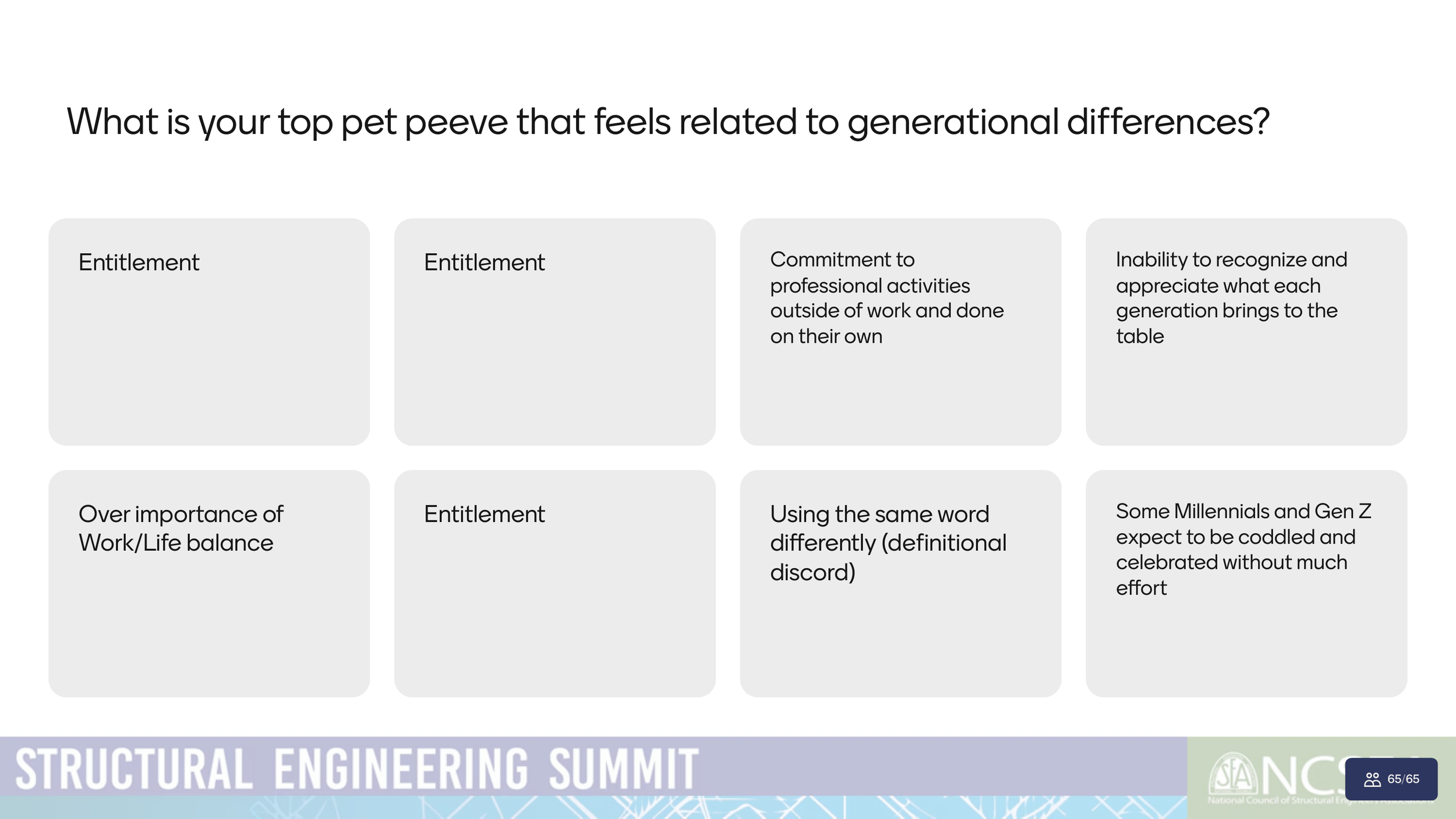
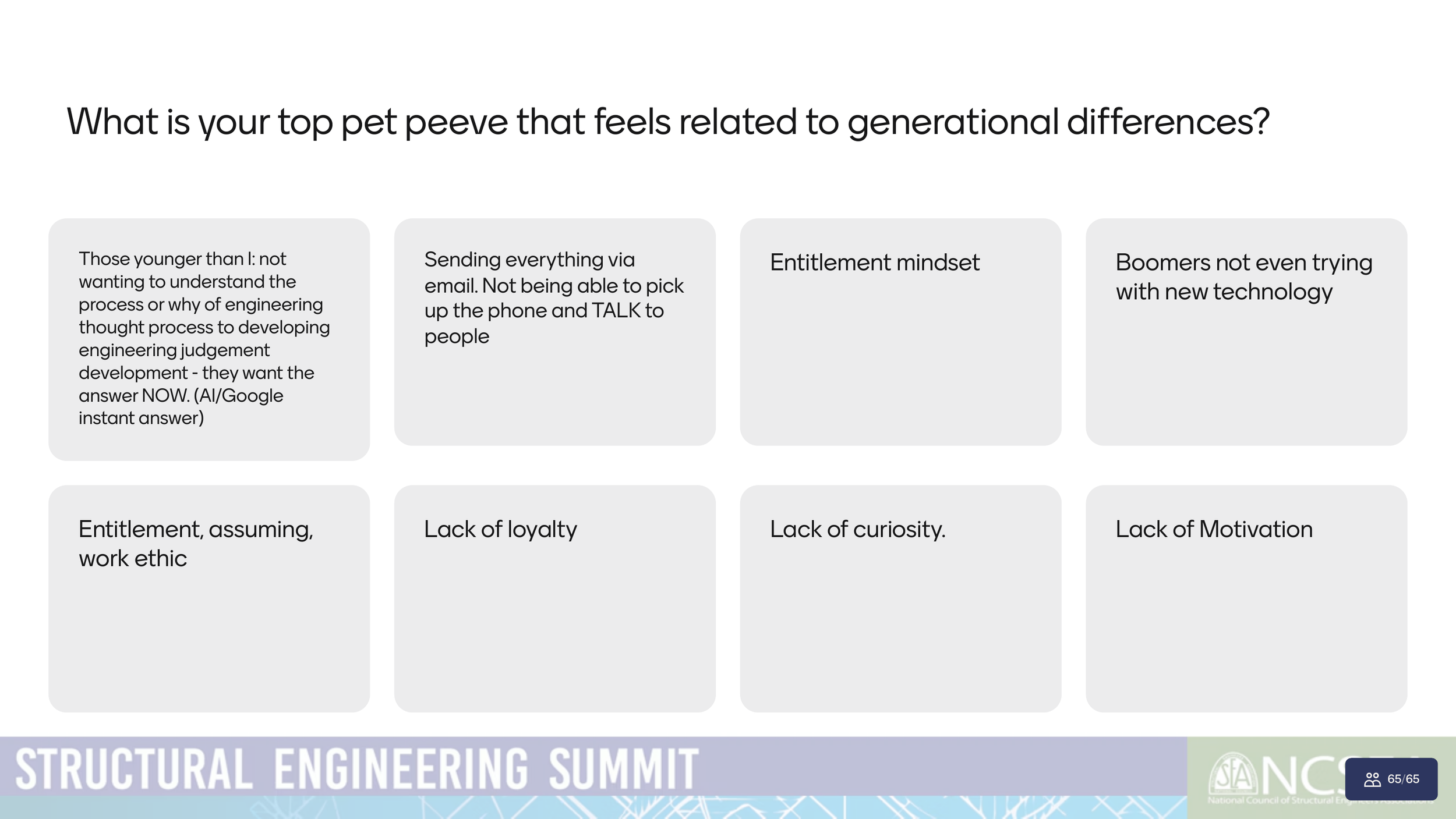
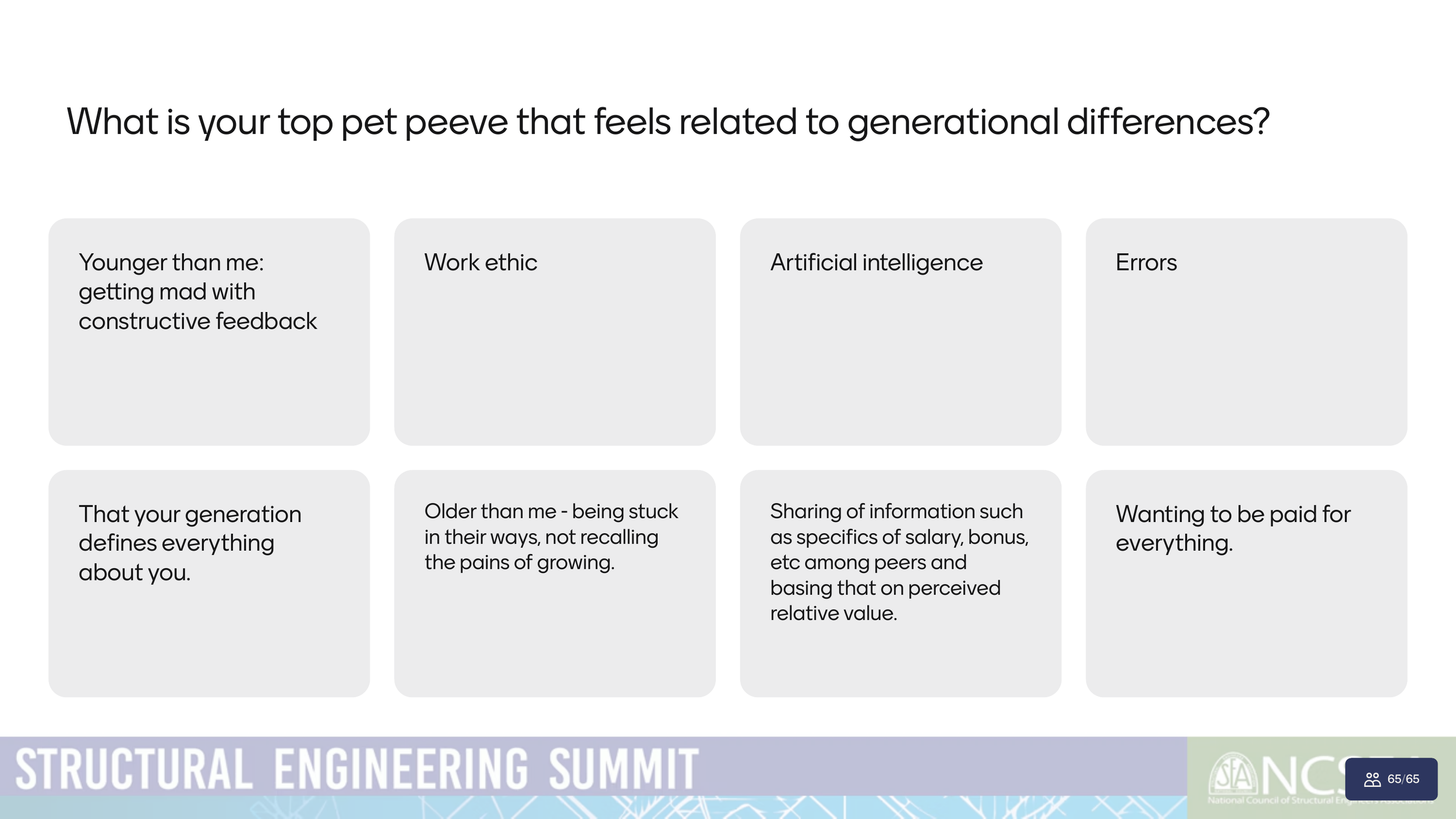
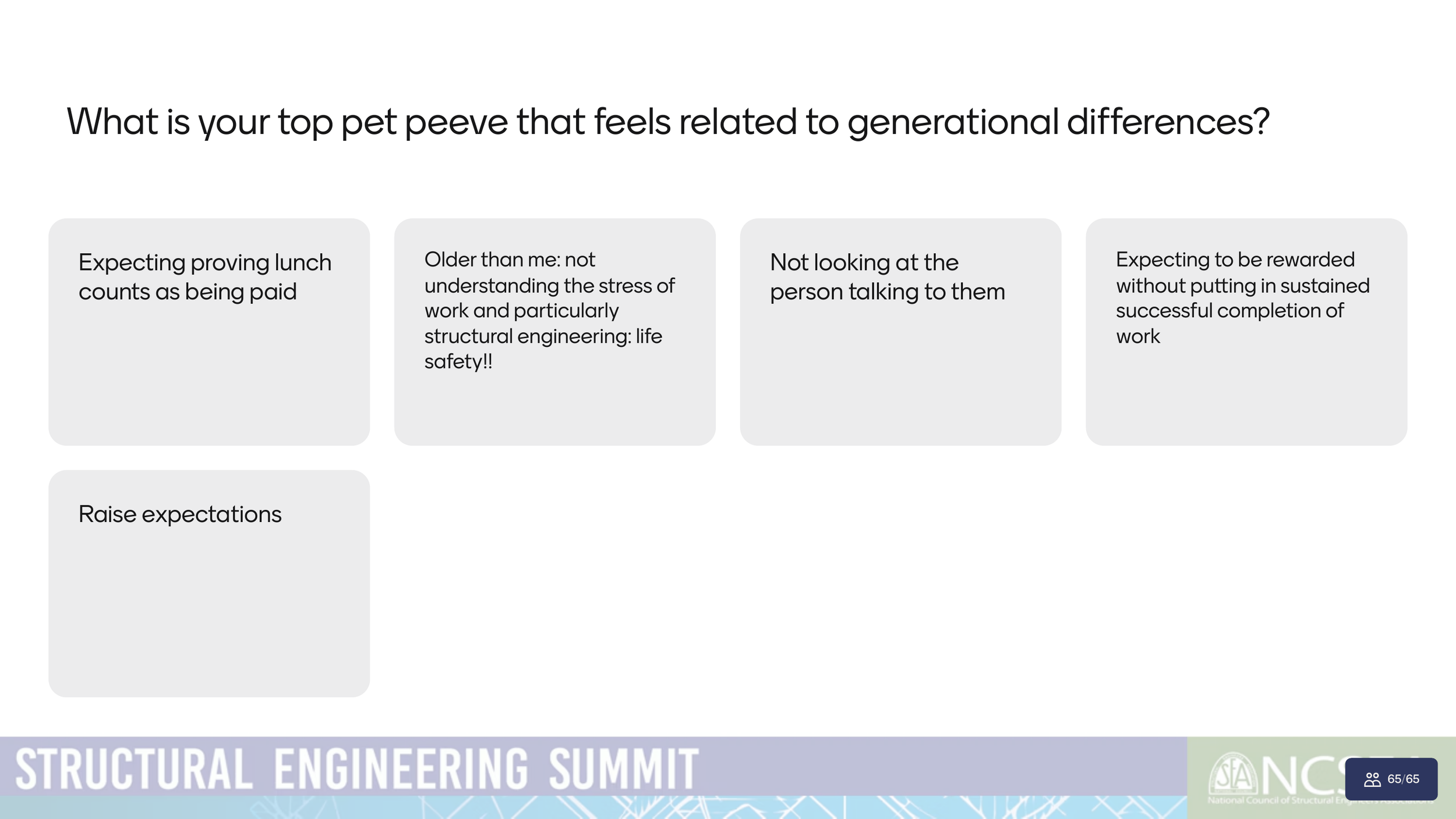
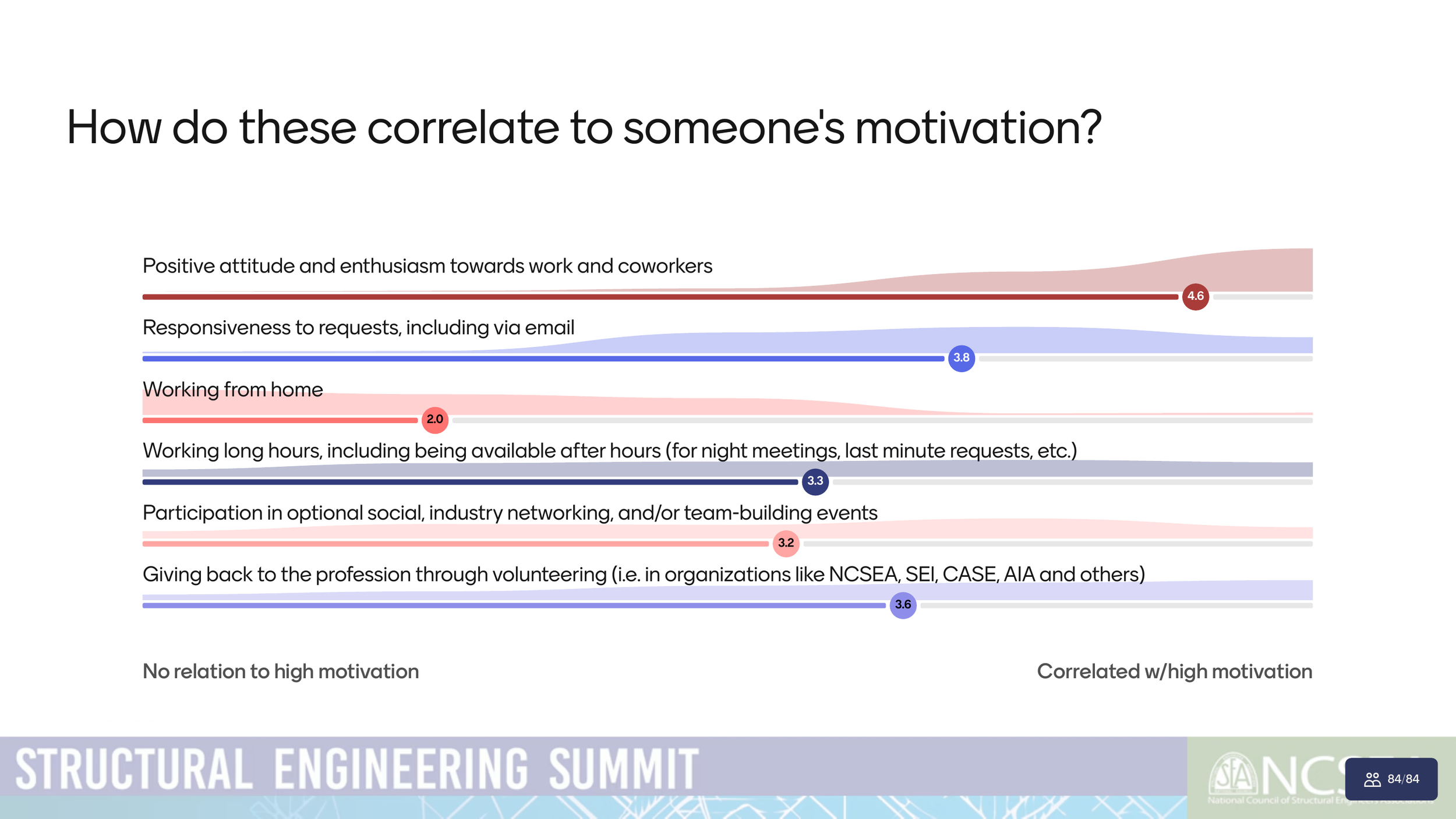
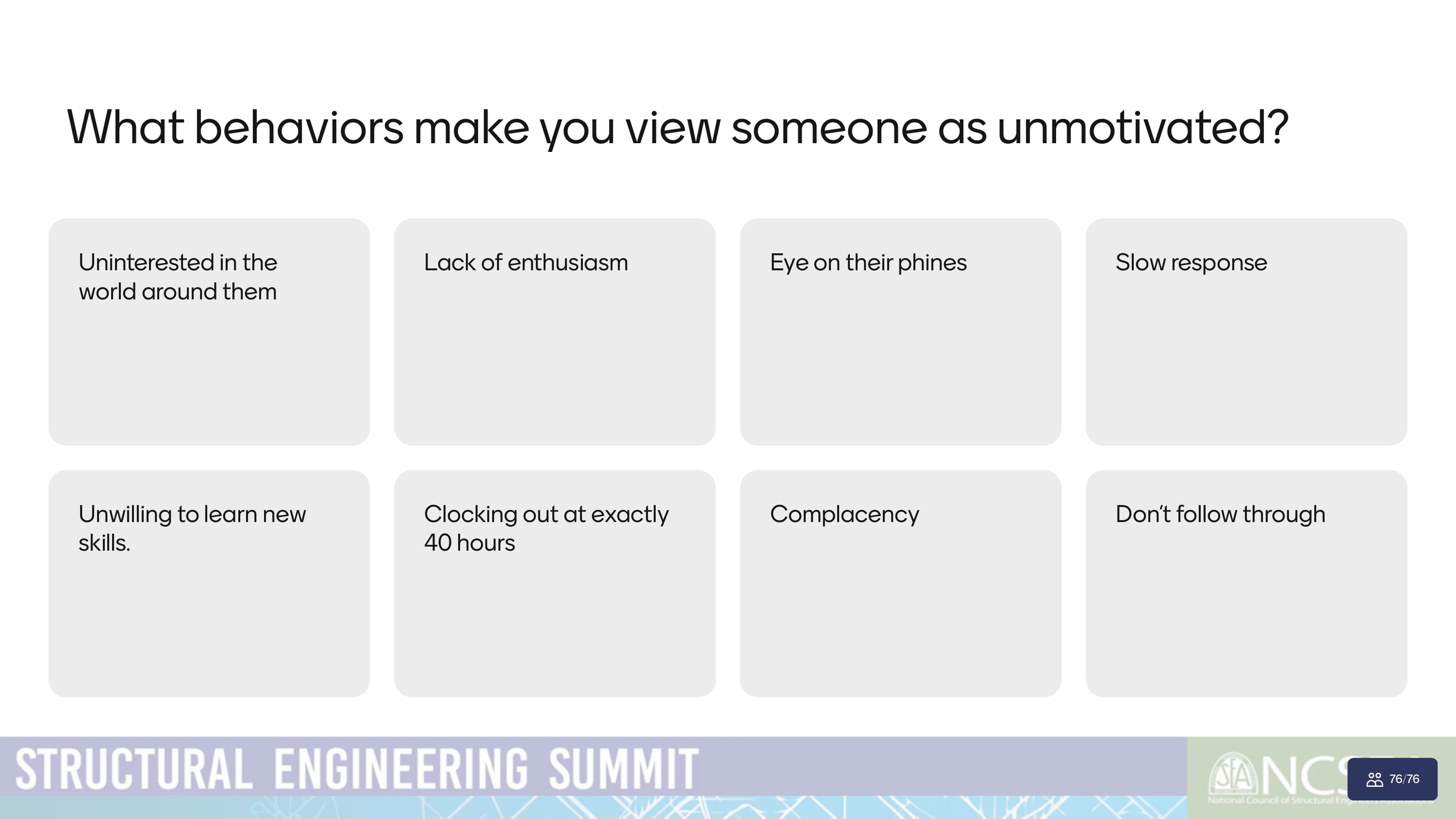
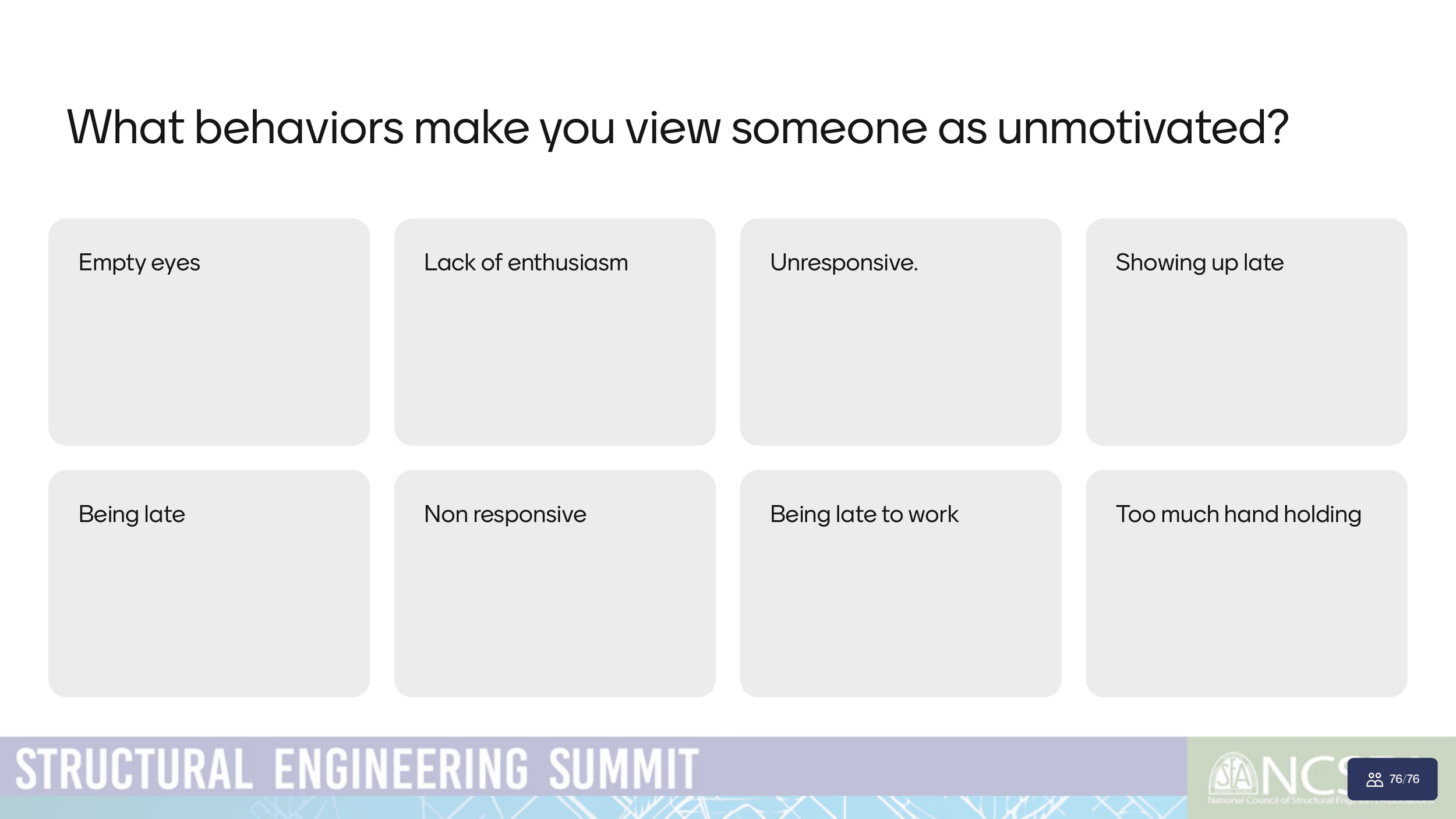
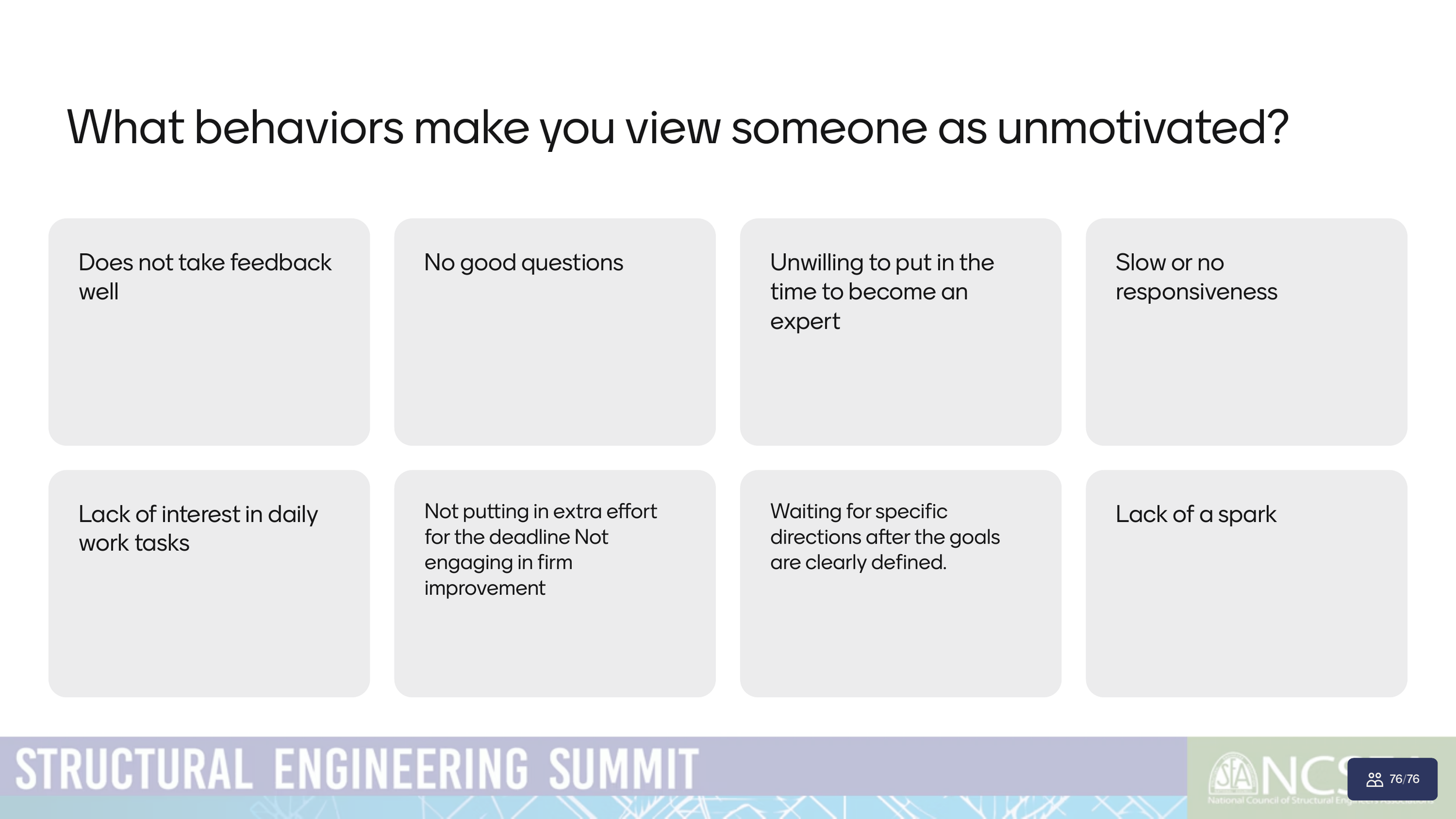
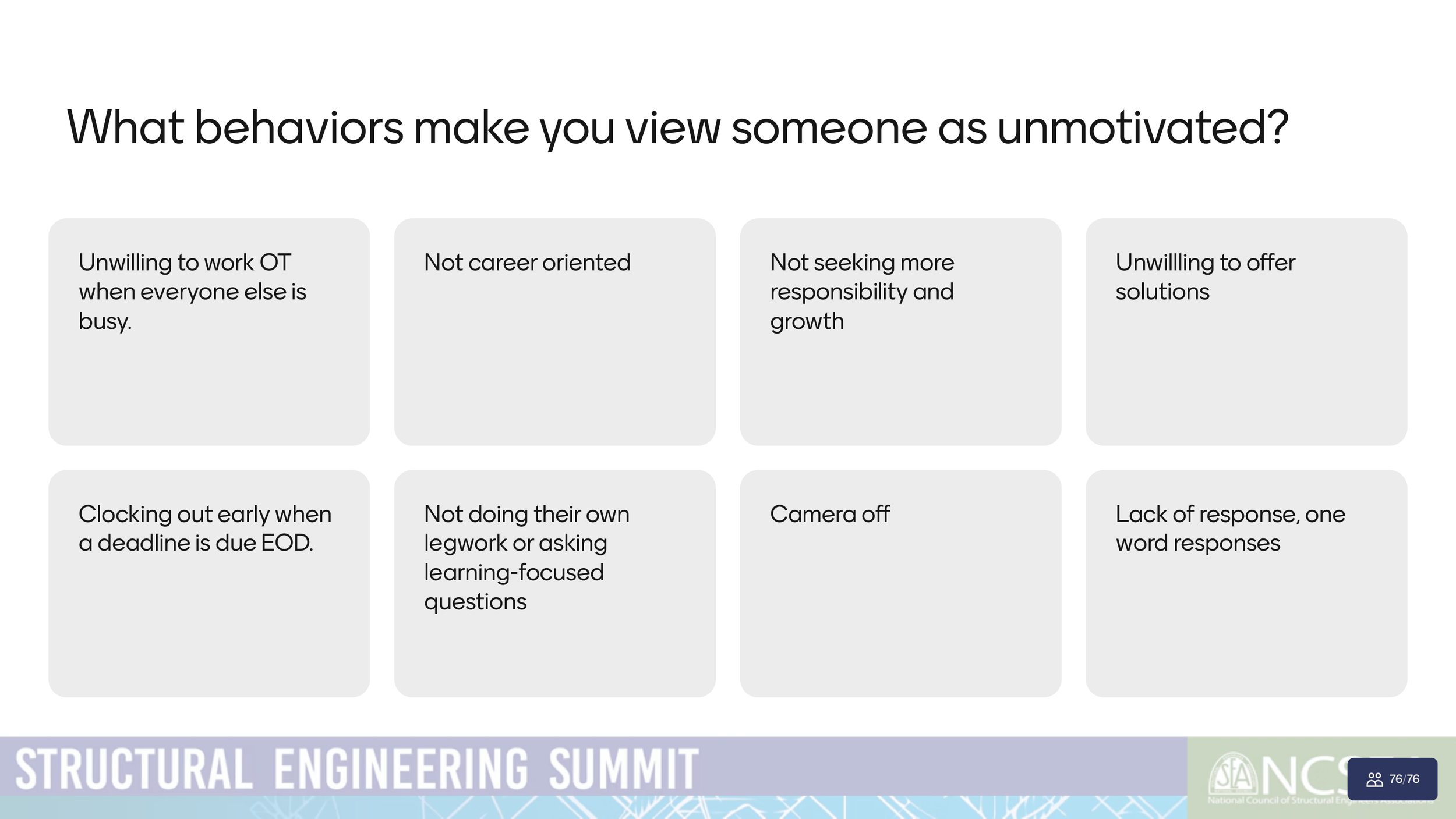
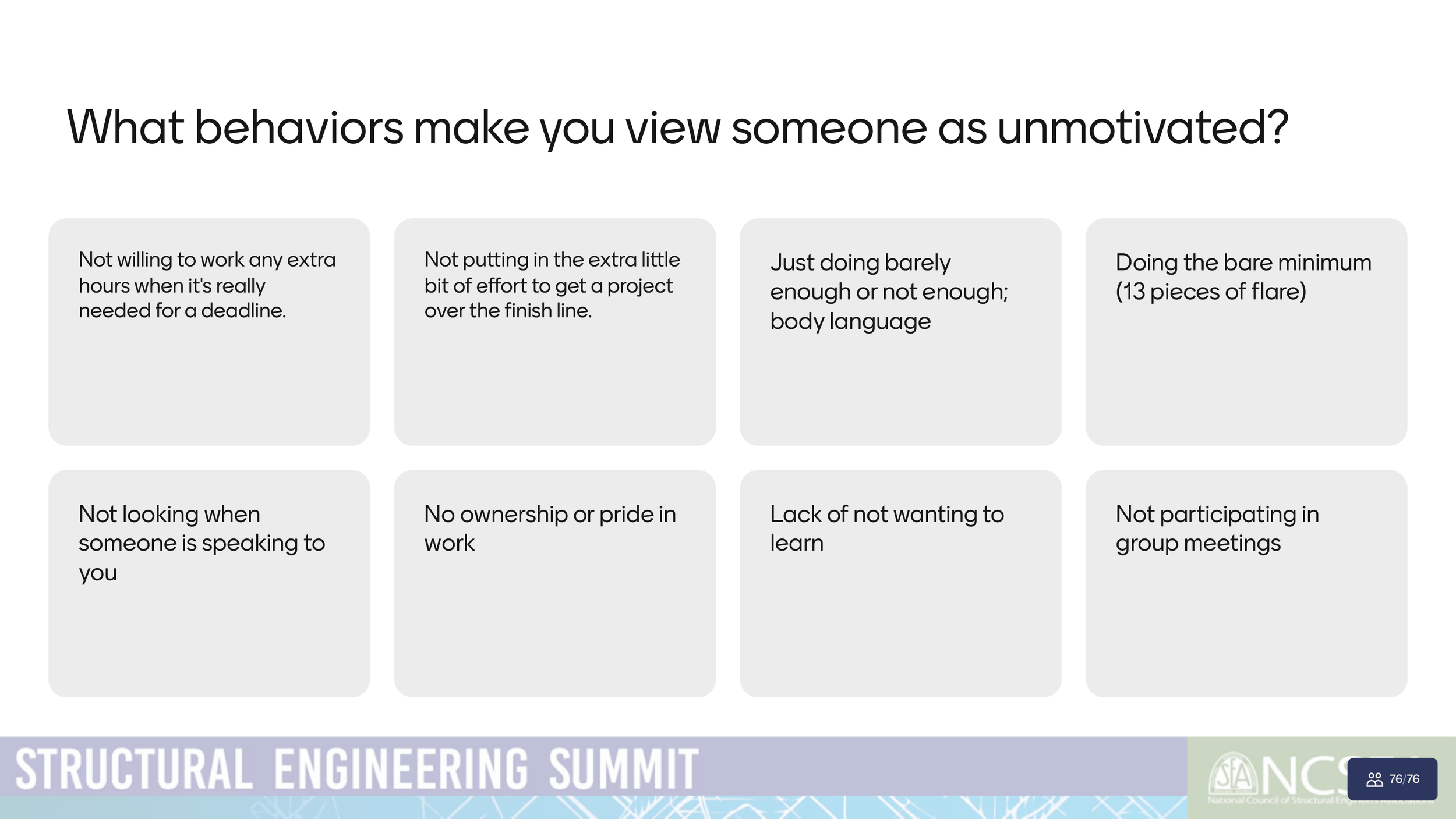
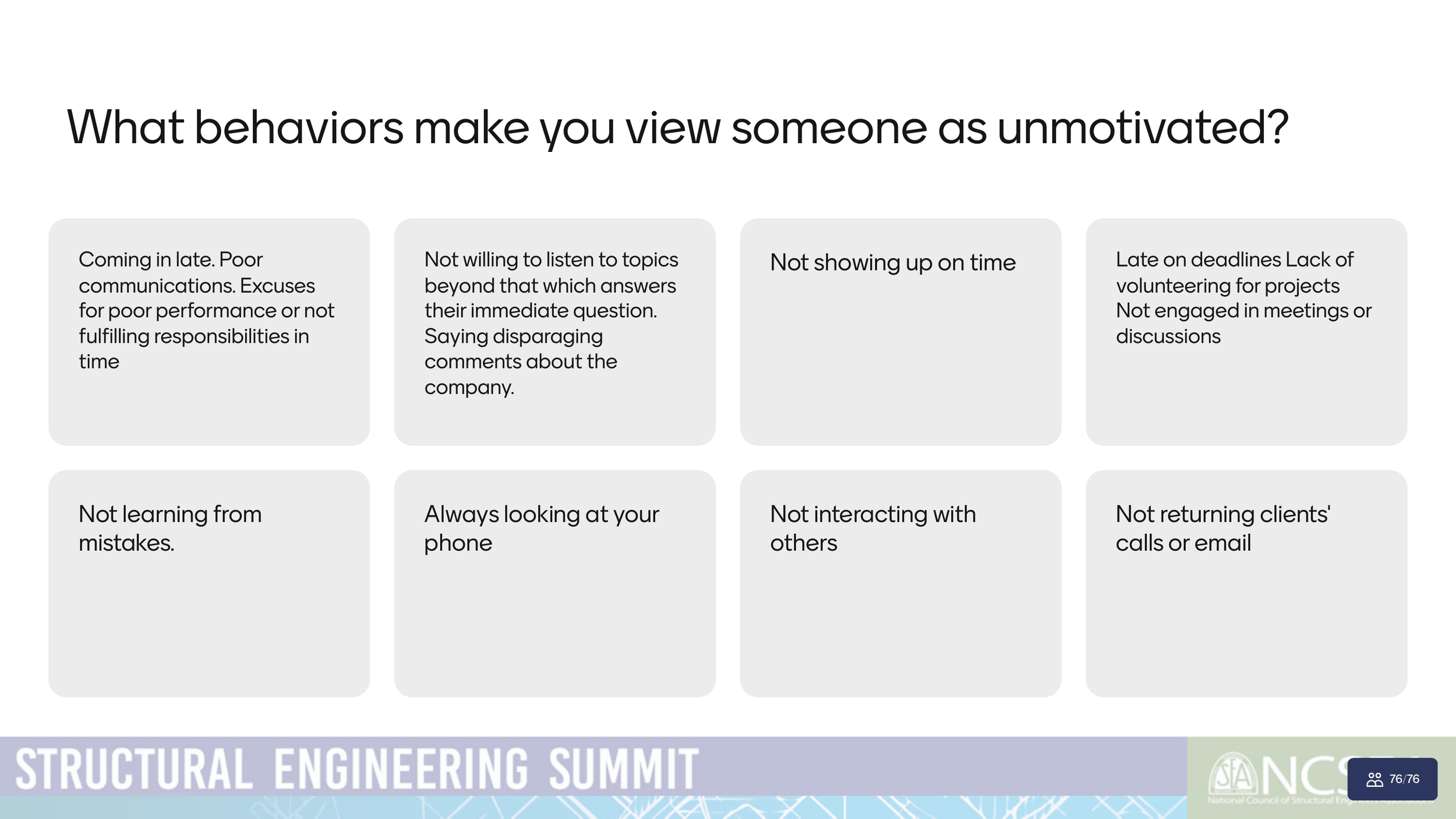
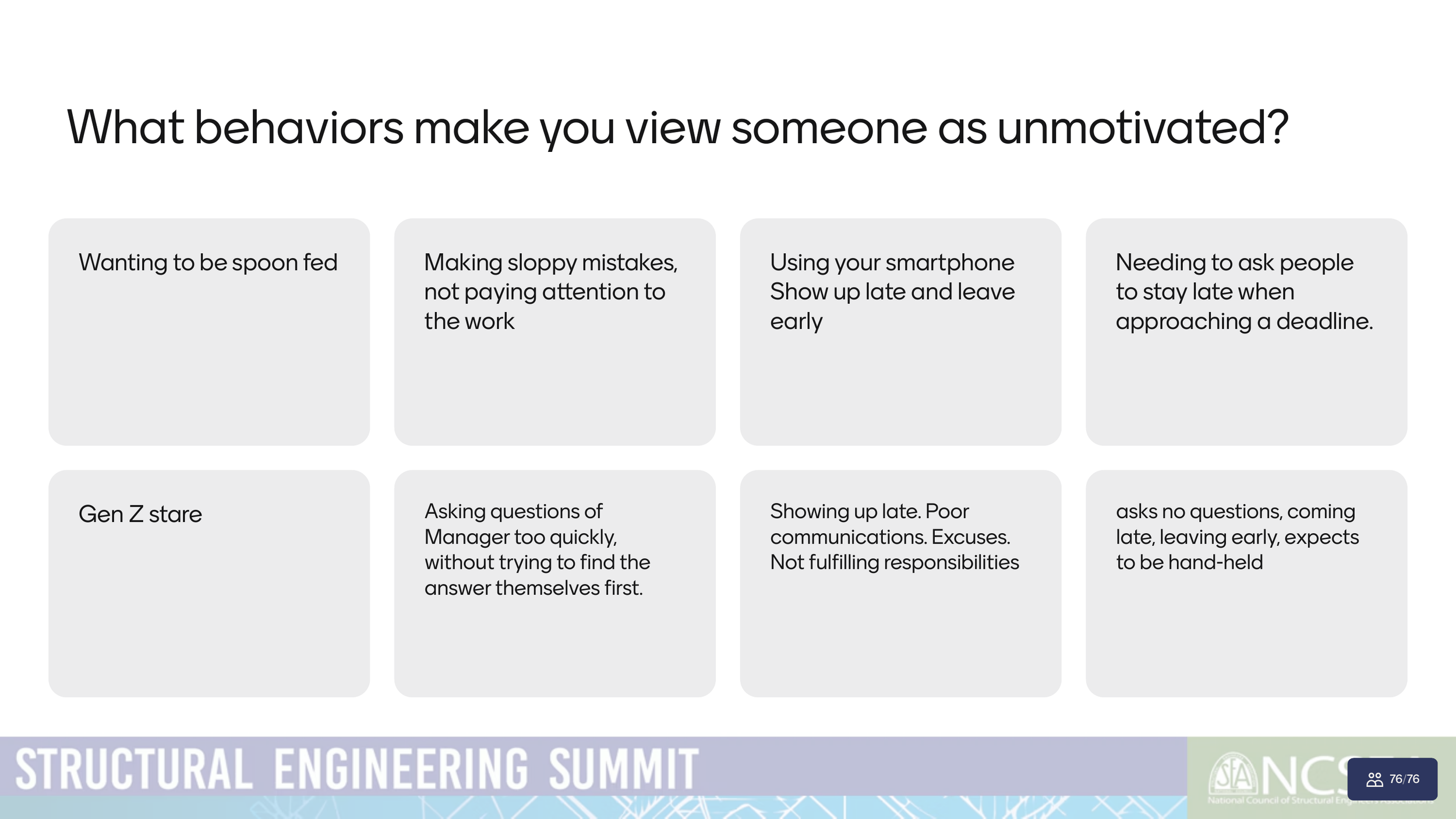
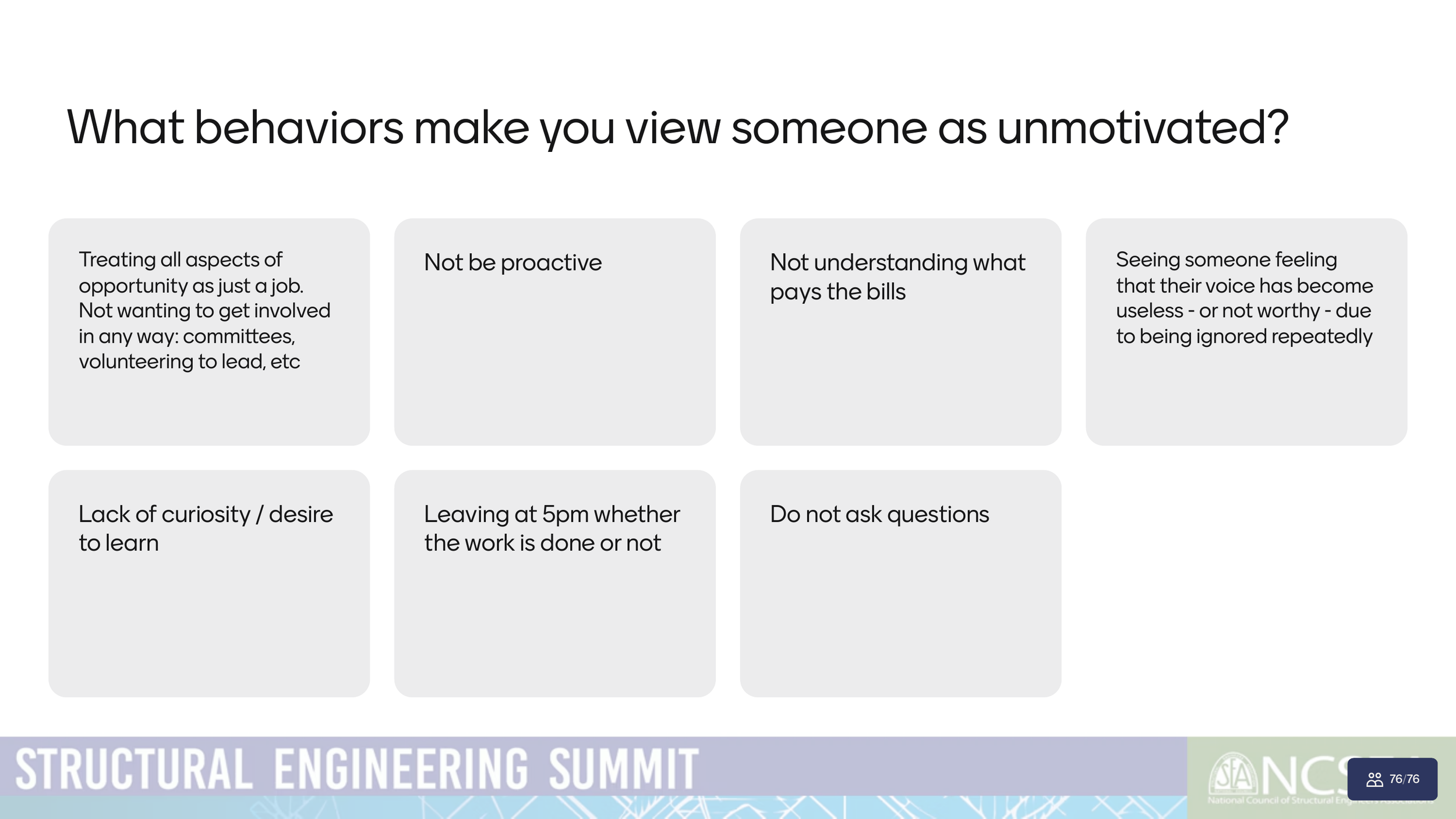
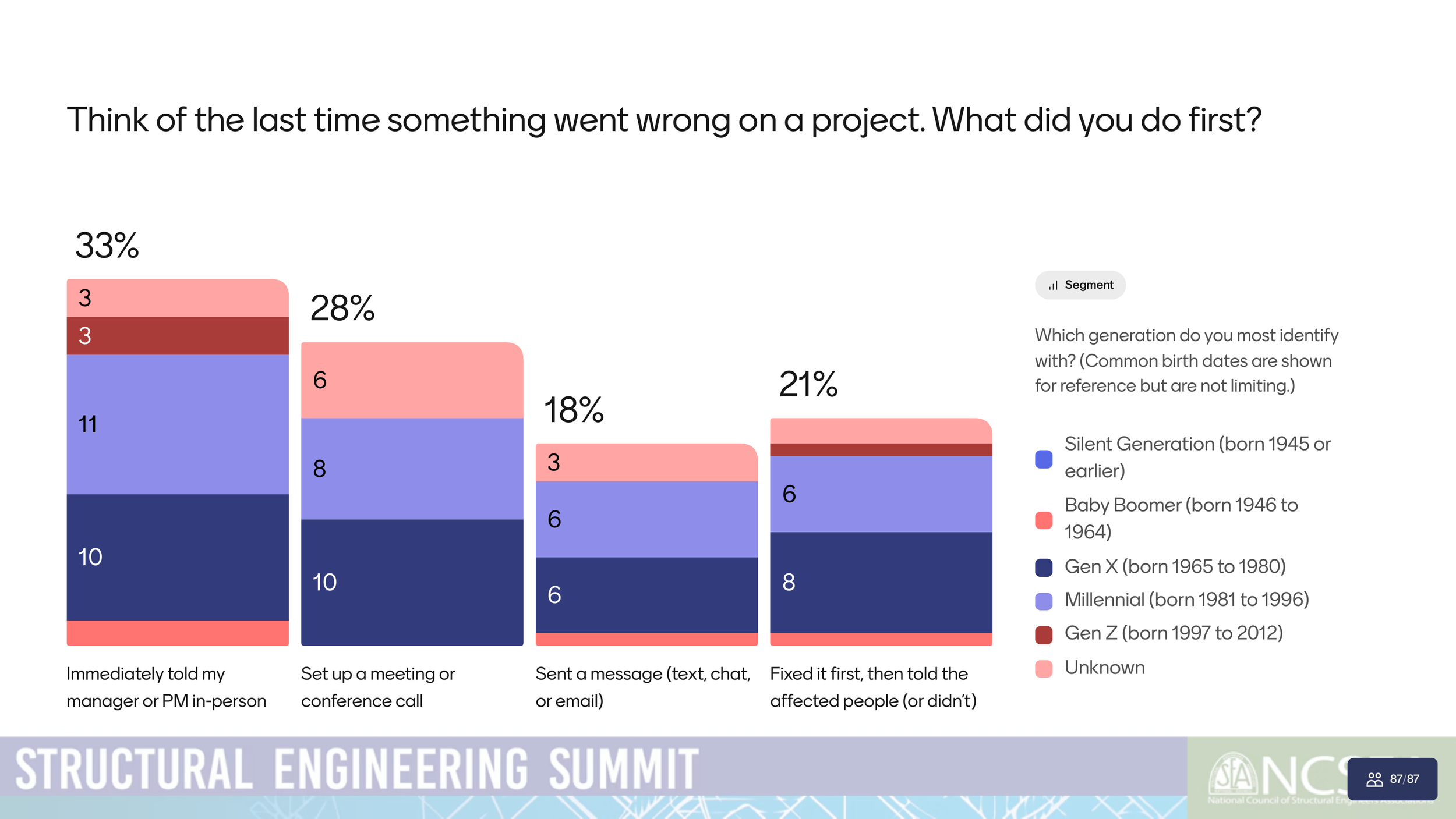
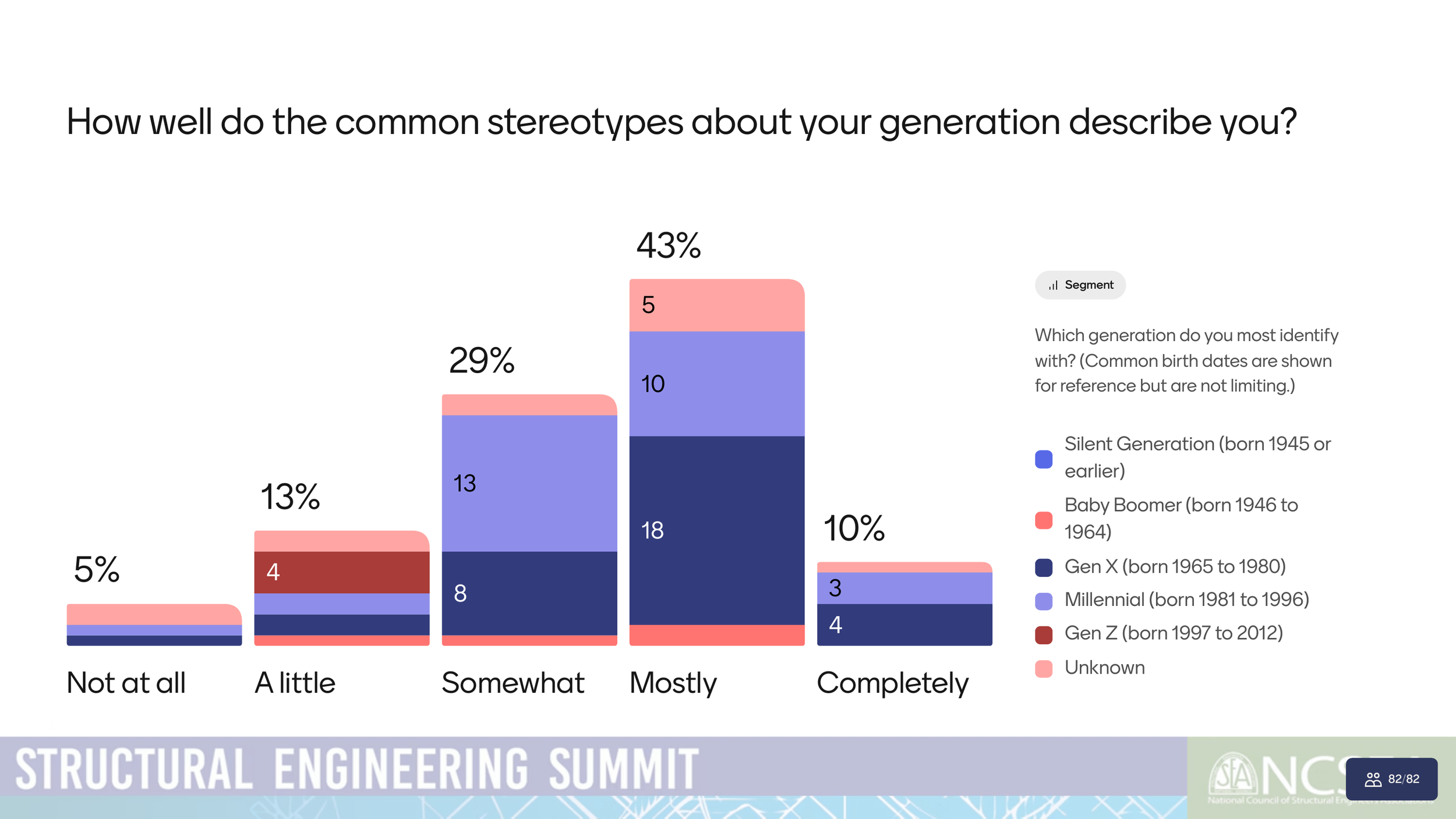
WHAT THE INTERNET SAYS ABOUT Generational Differences: Conversation Starters
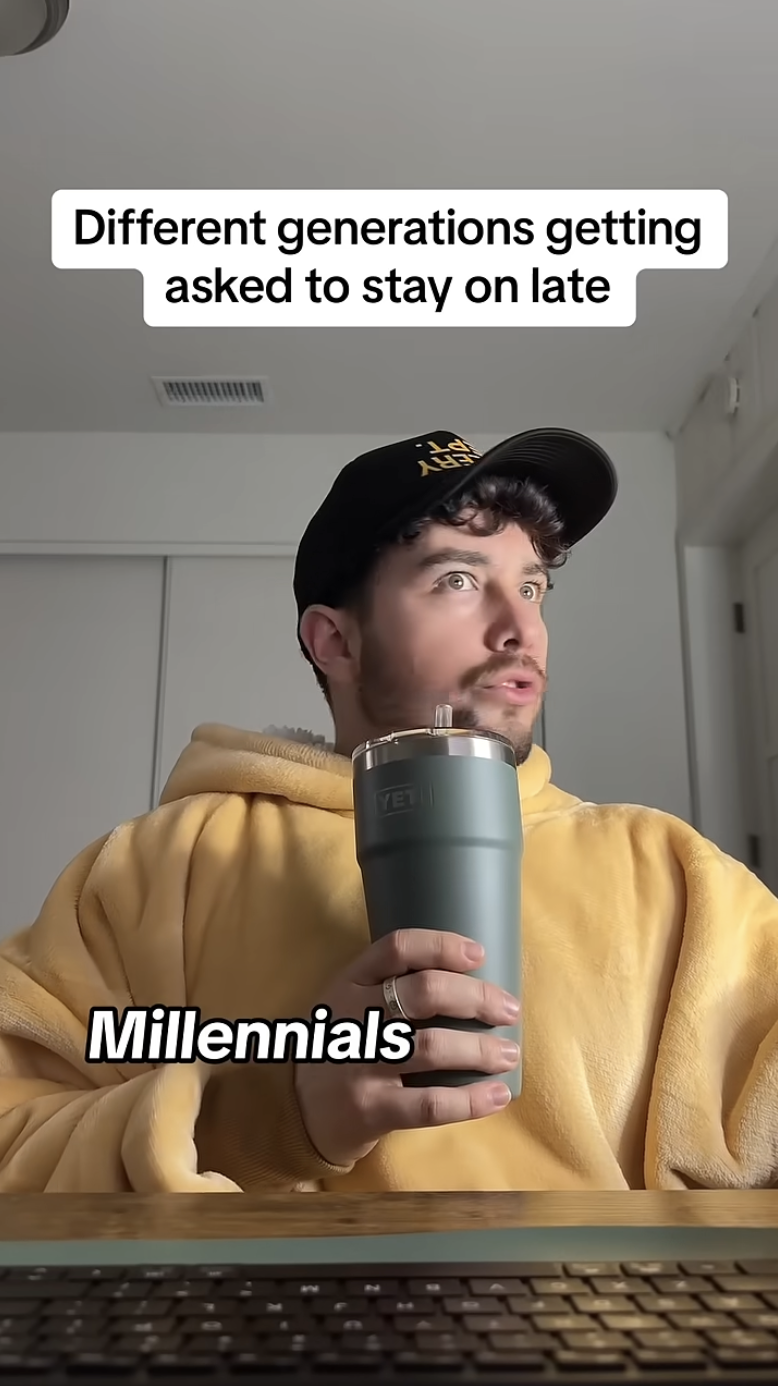
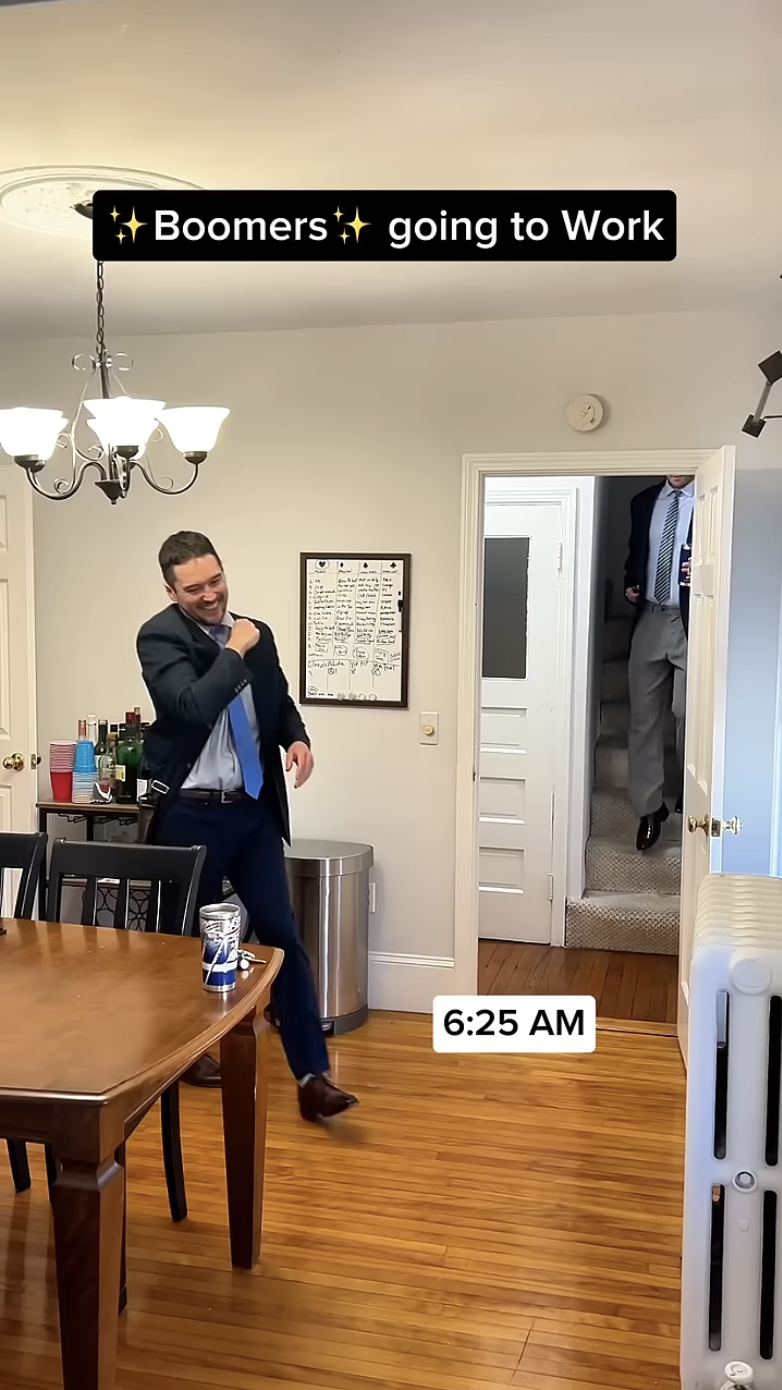
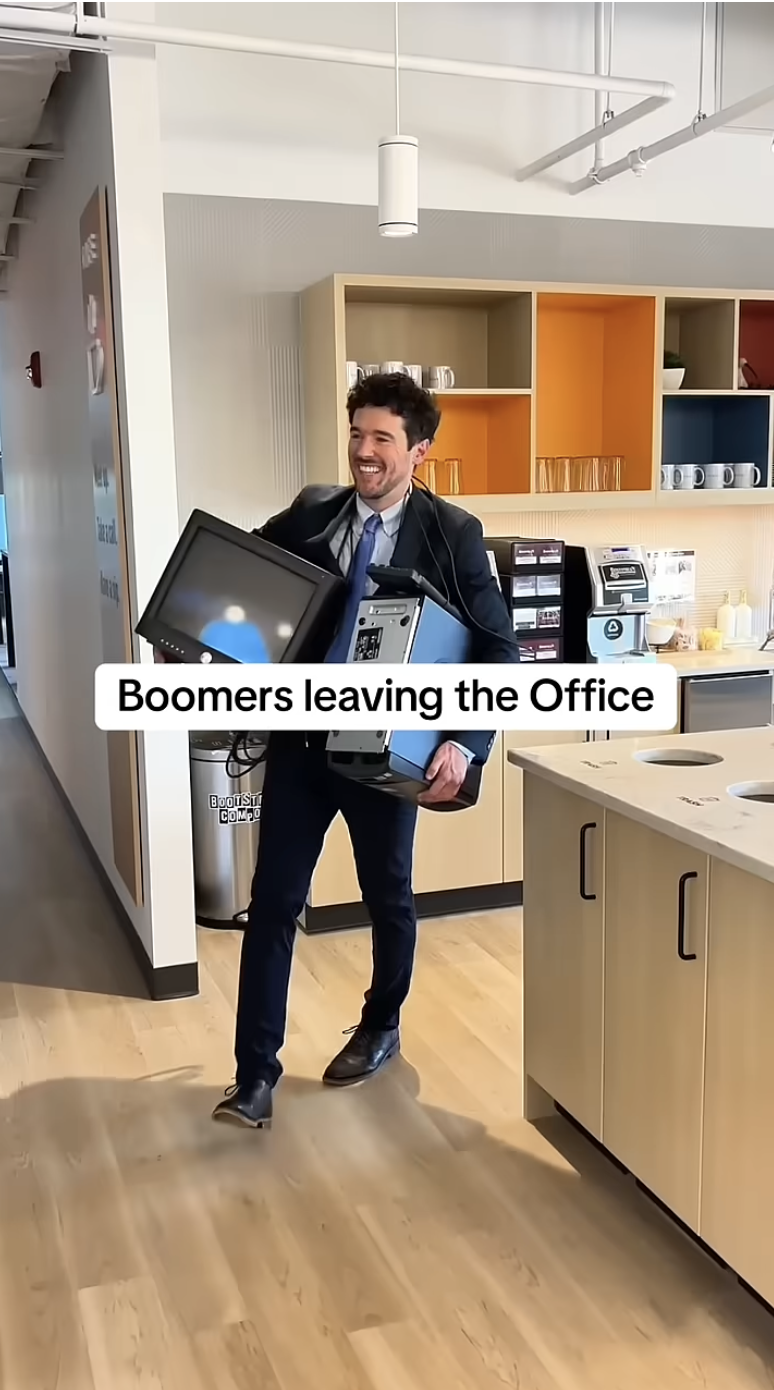
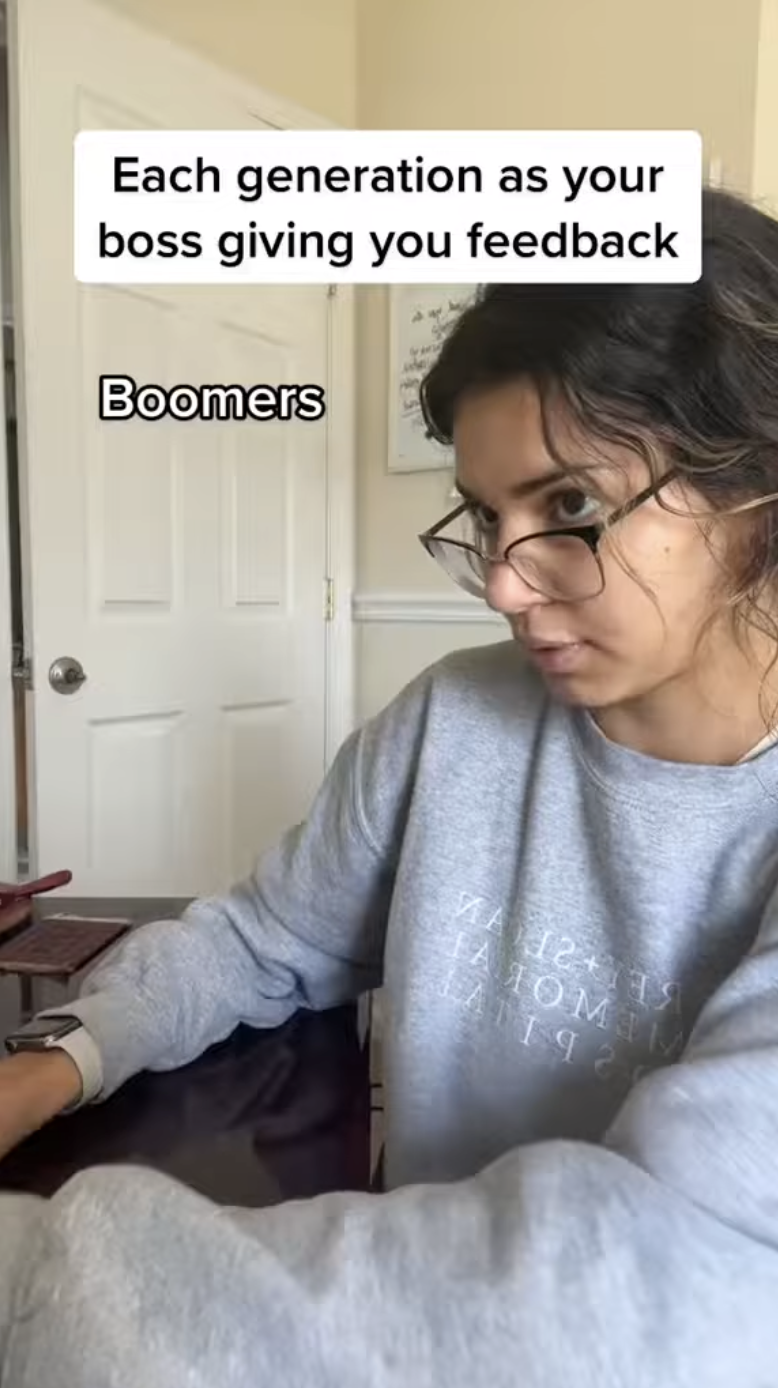
Below is a collection of humorous shorts that encapsulate “what the internet says” about generational differences. Watch one or two as a team, then use these questions to start the conversation:
Which video felt most like you? Which felt least like you?
Which stereotype about your generation do you wish people would drop, and which one is a little bit true?
What’s the most motivating thing that has ever happened to you at work? (Tell the story.)
What do you wish someone from a different generation understood about what it was like to start your career when you did?
What was “normal” at your first job (hours, feedback, leadership, external economic conditions, how people communicated) that you still carry with you, for better or worse?
When has someone from a different generation surprised you or changed how you saw something? (Tell the story.)
Generations getting a work call
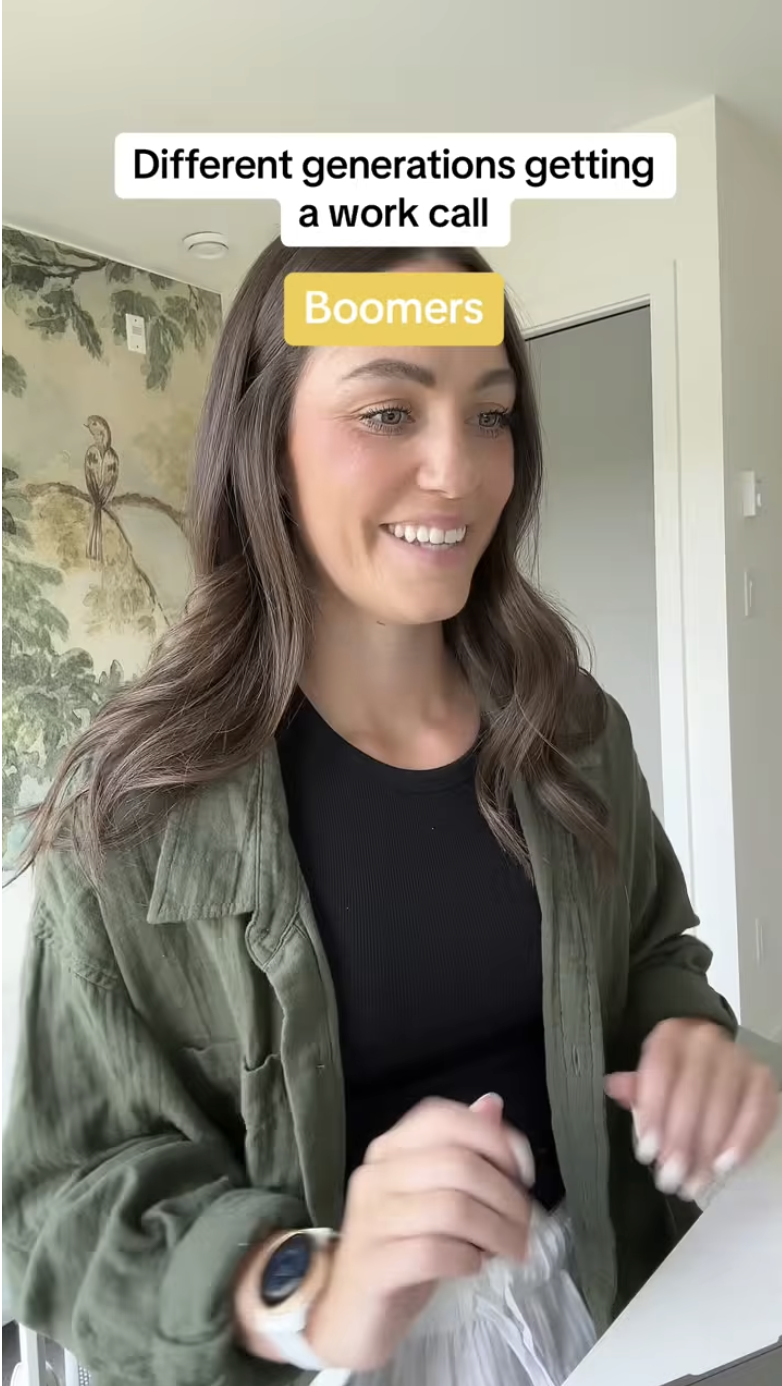
Generations using ChatGPT
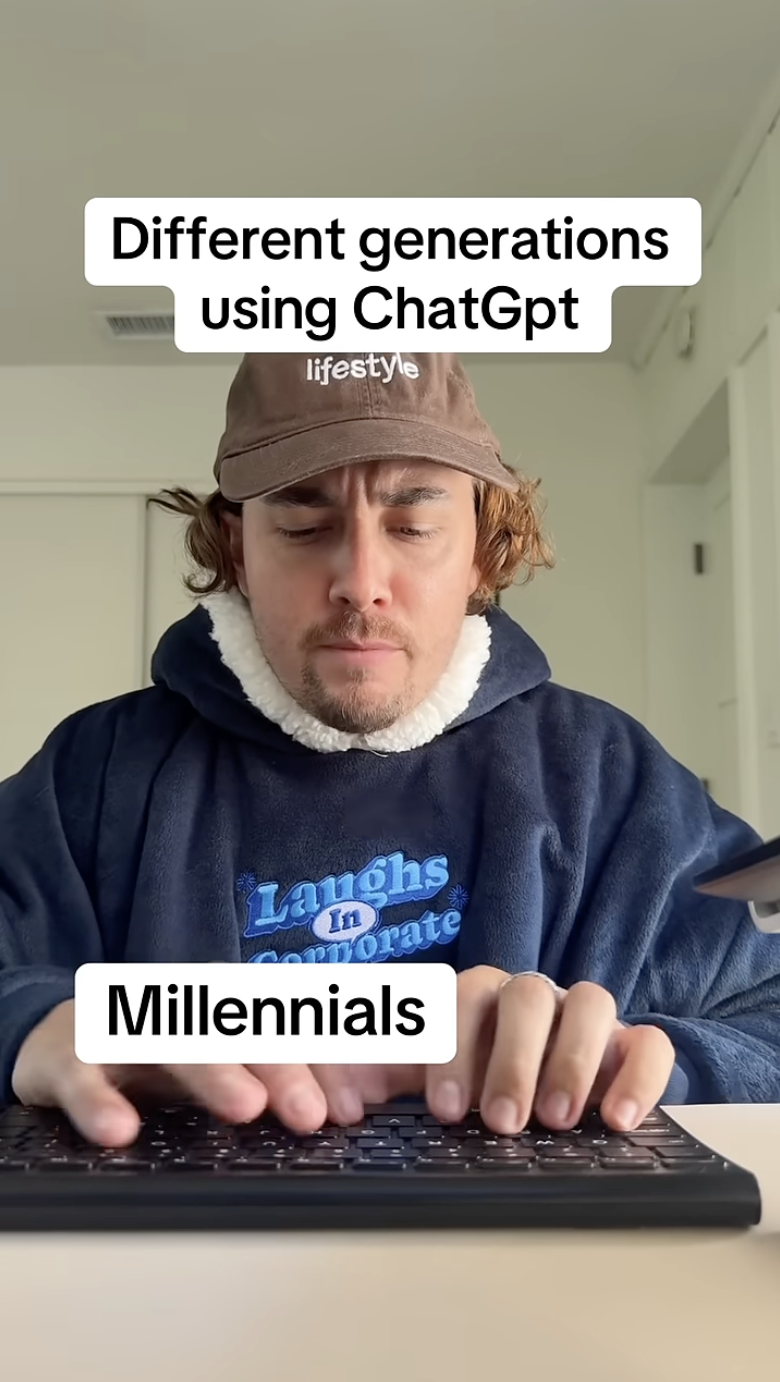
Generations being asked to stay late
How generations feel about going to work
Generations leaving the office
How different generations give feedback
Ambitions at work (watch first 30 seconds):

Stephanie Slocum note: The items below were compiled before the session to provide additional resources to assist you in navigating human differences in the workforce (generational or otherwise). The TL;DR takeaways and resources reflect my perspective and may not represent the views of all panelists.
Long hours and chronic overtime
TL;DR: Long hours aren’t a signal of motivation; effectiveness is. Temporary overtime happens. Chronic overtime is a management problem.
Why it matters: Even very resilient people can’t withstand chronic, predictable, unaddressed stressors forever. Burnout of your strongest people is a predictable response to a system problem, not a personal failing. And it’s not just senior leaders: partners and brand-new managers fall into it too, usually because no one trained them that what got them promoted (doing everything, having all the answers) leads to burnout at the next level.
To learn more:
Video: Chronic Stressor Trap: Why STEM High-Achiever Burnout Is a Systems Problem, Not a Personal Failing
Article: Burnout Is About Your Workplace, Not Your People (Harvard Business Review, Jennifer Moss)
Blog: 7 Tips for Setting Healthy Boundaries for Women in STEM
Try this:
There will always be more work to do in a day than you can do as a single human. Identify the daily tasks you do that align with what you enjoy doing and are aligned with your unique skills, gifts, and talents. Delegate, automate, or say no to the rest where possible.
Take steps to complete your stress cycle. There are external chronic stressors in our industry. These can vary between firms, but they don’t “go away” even when you switch roles. So, while it is important to manage then and firms can take steps to do so by putting in place systems, you WILL burnout if you do not complete your stress cycle on a daily basis. Watch the “chronic stressor trap” video linked above for the science behind this, including examples for structural engineering firms of systems that can help manage the external chronic stressors.
Firm leaders: Clients and contractors routinely push on boundaries with scope creep and extra work (and you know this from your decades of experience). Rather than leave it up to the individual to resolve, mentor your staff explicitly on where you expect them to draw the line. Examples: Do you have an explicit “do not send emails” after-hours or vacation and do your firm leaders model that behavior? When a client sends a last minute request to change something before the deadline, or a contractor sends something at 4pm every Friday and requests a response ASAP, what is the firm protocol?
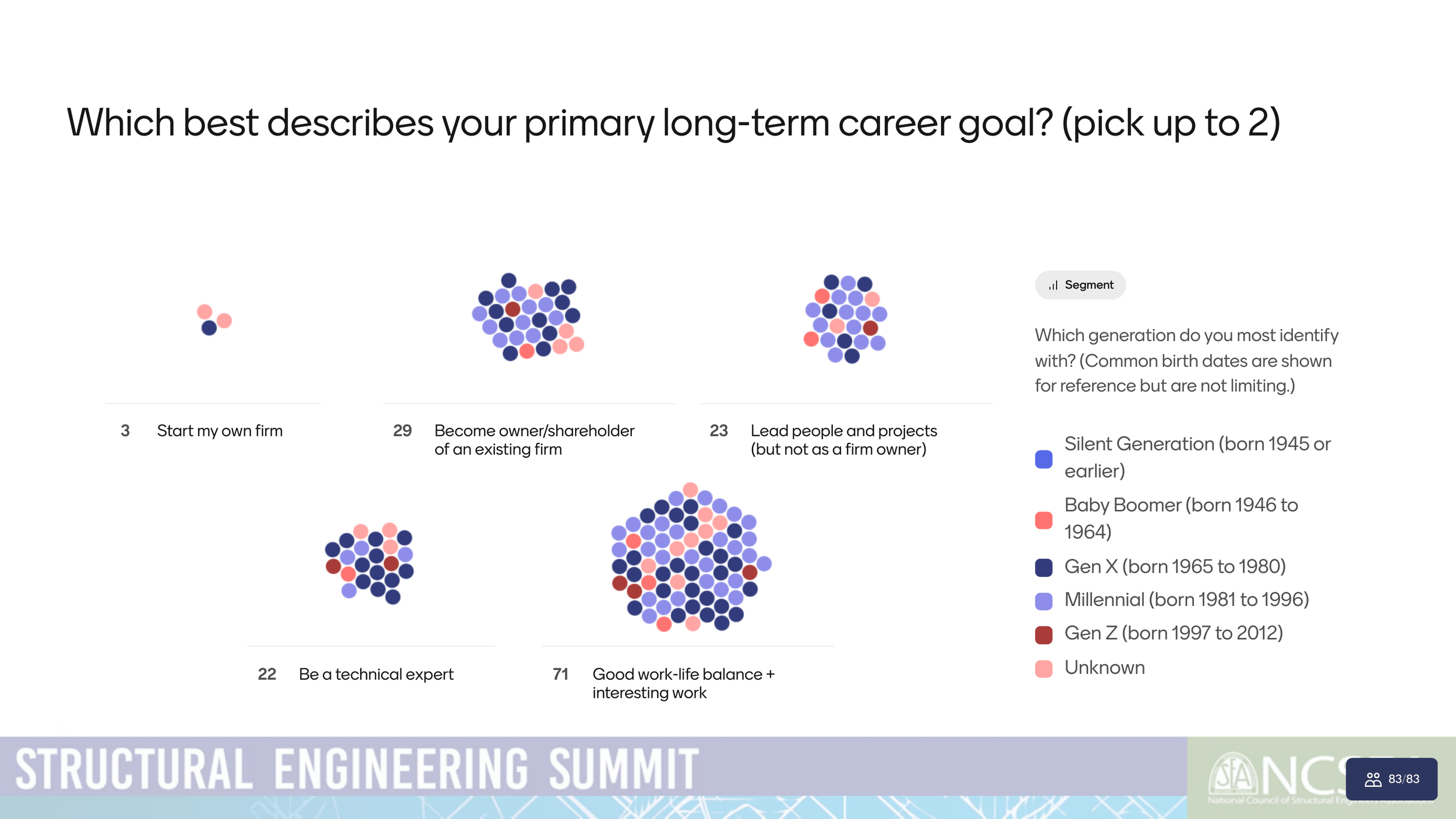
Ambition and career paths
TL;DR: Generations and individuals have different definitions of “ambition”, and younger generations prioritize working to live (not living to work). High-acheiving engineers’ expectations today: growth career path and a full life outside work.
Why it matters: As one newly licensed PE put it: “I expect to have it all. I’ll work hard and smartly at my job and expect to get promoted for excelling, and I expect to be able to leave work at 5 more times than not.”
To learn more:
Article: How to Conduct Stay Interviews: 5 Key Questions (SHRM)
Blog: 9 Strategies That Help STEM Organizations Retain Women (see individualized development and clear promotion paths, and although I haven’t done mixed-gender research, much of this aligns with retention best practices)
Try this:
Be explicit about your own career ambitions at work. That includes but is not limited to: projects you want to work on, resources you need to be successful in your role, things you want to learn, and if you want a promotion or raise. It has been my experience in working with and coaching or training engineers on self-advocacy that the person who asks, receives more often than not. The reverse is also true: if you don’t ask, you don’t (usually) get what you want.
Have a career conversation about where you see yourself going in your organization, and what that looks like for you (i.e. I plan to be a principal and model work-life balance for the people I am managing). This is particularly important if you feel there are incorrect assumptions being made about your ambition.
For managers and organizations struggling to retain people: run a stay interview (see questions in the “to learn more” in this section with one person you can’t afford to lose, before they’re updating their resume. Ask: “What’s one thing I could do to make your job better?” Then act on one answer within two weeks and tell them you did.
For organizations: Write down what it takes (skills, experience, etc.) to reach the next level at your firm. If you can’t explain it, your people can’t either. All high-achievers want to grow, and if you’ve hired good people, most will eventually leave if there is no growth path.
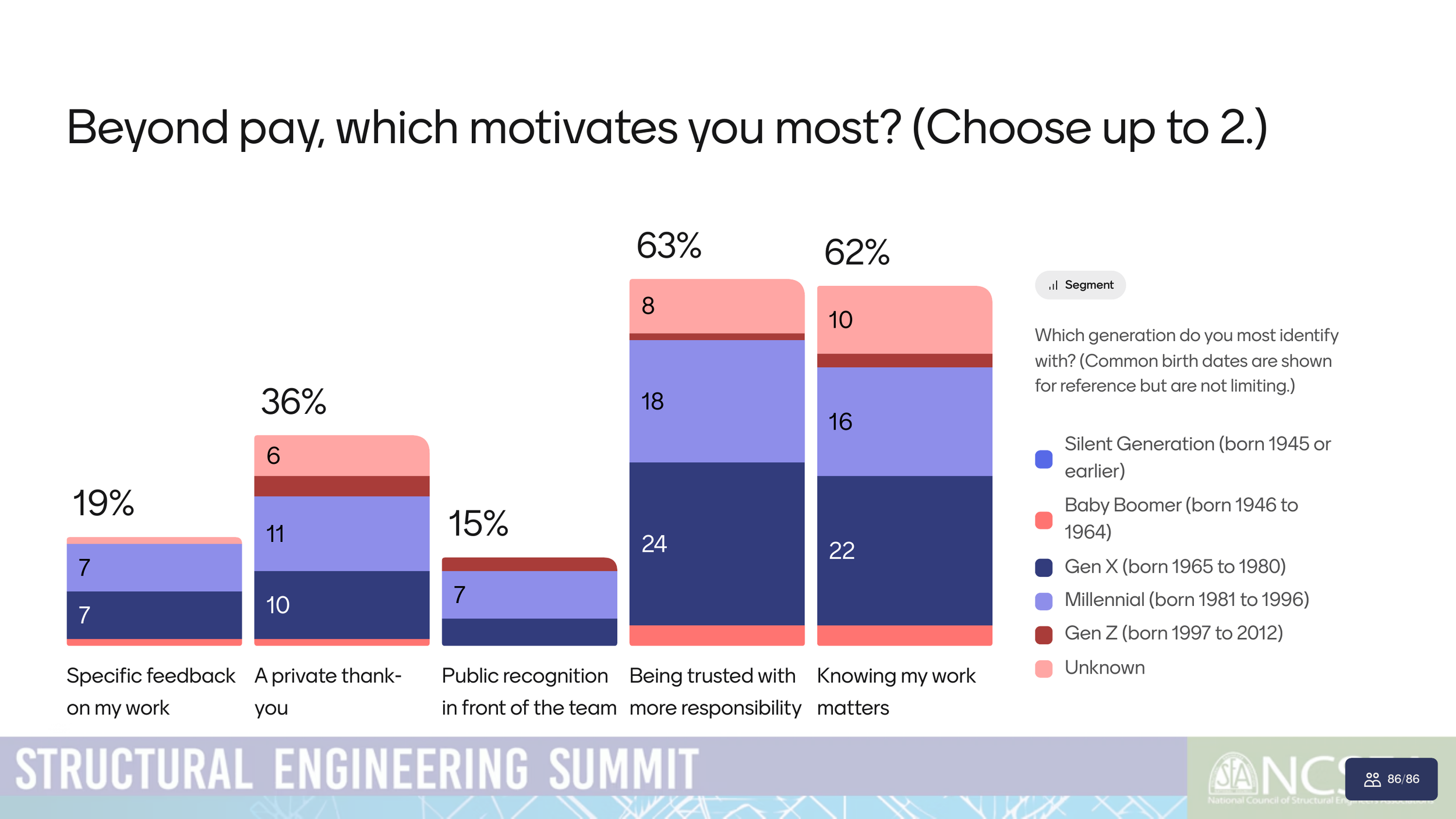
Feedback and recognition
TL;DR: All individuals are motivated by feedback and recognition, although the frequency desired and how to deliver it vary by individual. Understanding what good feedback looks like and how to give it is a skill that engineers need to develop.
Why it matters: How much feedback you want often reflects what was “normal” when you started working, which is shaped by both your generation and how you were raised:
Typical feedback growing up by generation*
Boomers: Little to none, unless they did either something wrong or extraordinary
Gen X: Latchkey kids; little to none
Millennials: Lots of feedback and recognition
Gen Z (digital natives): Instant feedback (consider the speed at which digital tools provide this!), all the time
*Generalizations do NOT represent everyone, and some of this is more related to who raised you (i.e. a Gen X raised with a stay-at-home parent, and anyone raised by a grandparent or in a single-parent household are likely to have wildly varying experiences). These are patterns, not predictions. Some people who got little feedback as kids want more validation as adults, and other factors play into an individuals’s needs. You don’t know until you ask.
To learn more:
Blog: The Human-Centered STEM Leader’s Guide to Giving Good Feedback (FBI framework, with examples)
Blog: How to Get Actionable Feedback That Fuels Your STEM Career Growth
Book: Radical Candor by Kim Scott (free articles and podcast at www.radicalcandor.com)
Article: What Good Feedback Really Looks Like (Harvard Business Review)
Try this for positive feedback: See something good, say something good. This week, give one person a specific thank-you using this formula: thank you + the specific thing they did + the specific impact. For example:
“Thank you for your attention to detail in those calculations. Getting that right the first time had a big impact on our ability to get the project out on time.”
Build trust with a pattern of positive, specific praise before you give critical (or negative) feedback. People need several positive interactions with you for every critical one before criticism lands as help. Note that “positive” means they left their interaction with you feeling good (as opposed to negative or neutral). In Zenger and Folkman’s research on teams, the highest performers averaged about 5.6 positive comments for every negative one (Harvard Business Review): The Ideal Praise to Criticism Ratio. It is my experience that even getting this to a 2 positive: 1 negative/neutral dramatically improves coworker and team working relationships and productivity.
Try this for critical feedback: First and foremost, only give critical feedback if you are giving it from the perspective of helping the other person grow (not when you are frustrated or you want it done your way). Read THIS blog for a simple framework to give critical feedback, and why the traditional “feedback sandwich” doesn’t work.
Communication
TL;DR: Follow the platinum rule: communicate with people the way they want to be communicated with. How you prefer to communicate is not necessarily what others prefer. Often, communication problems start when we make assumptions that other’s communications style matches our own.
Why it matters: The panel split on the phone (call me vs. Teams me first), and no one is wrong. Not meeting someone halfway on how you communicate is demotivating, whatever generation you’re in.
To learn more:
Article: Managing a Polarized Workforce (Harvard Business Review - pay attention to the listening triangle piece relative to communication)
Try this: conversation starters for communication
“I want to work well with you. How do you want me to reach you if something is time sensitive or an emergency?”
“What’s the best way to get a quick answer from you? What about a decision that needs discussion?”
Set a team rule around when written communication needs to go to another format (meeting, call, etc.) and say it out loud. The rule I gave my engineering staff as a manager: if 3 emails haven’t resolved it, call the person you’re talking to. (This was spurred by the time I was forwarded a ~15-message email chain that extended over two weeks of time - a 15 minute phone call resolved the issue, and that was days of billable time wasted if you add up all the time spend writing and responding to emails.)
Build trust by starting your next remote call with one non-work question before the agenda, like “What’s one good thing from your week?”
“What’s one communication “pet peeve” you have? I want to know so I don’t do that!”
The bottom line
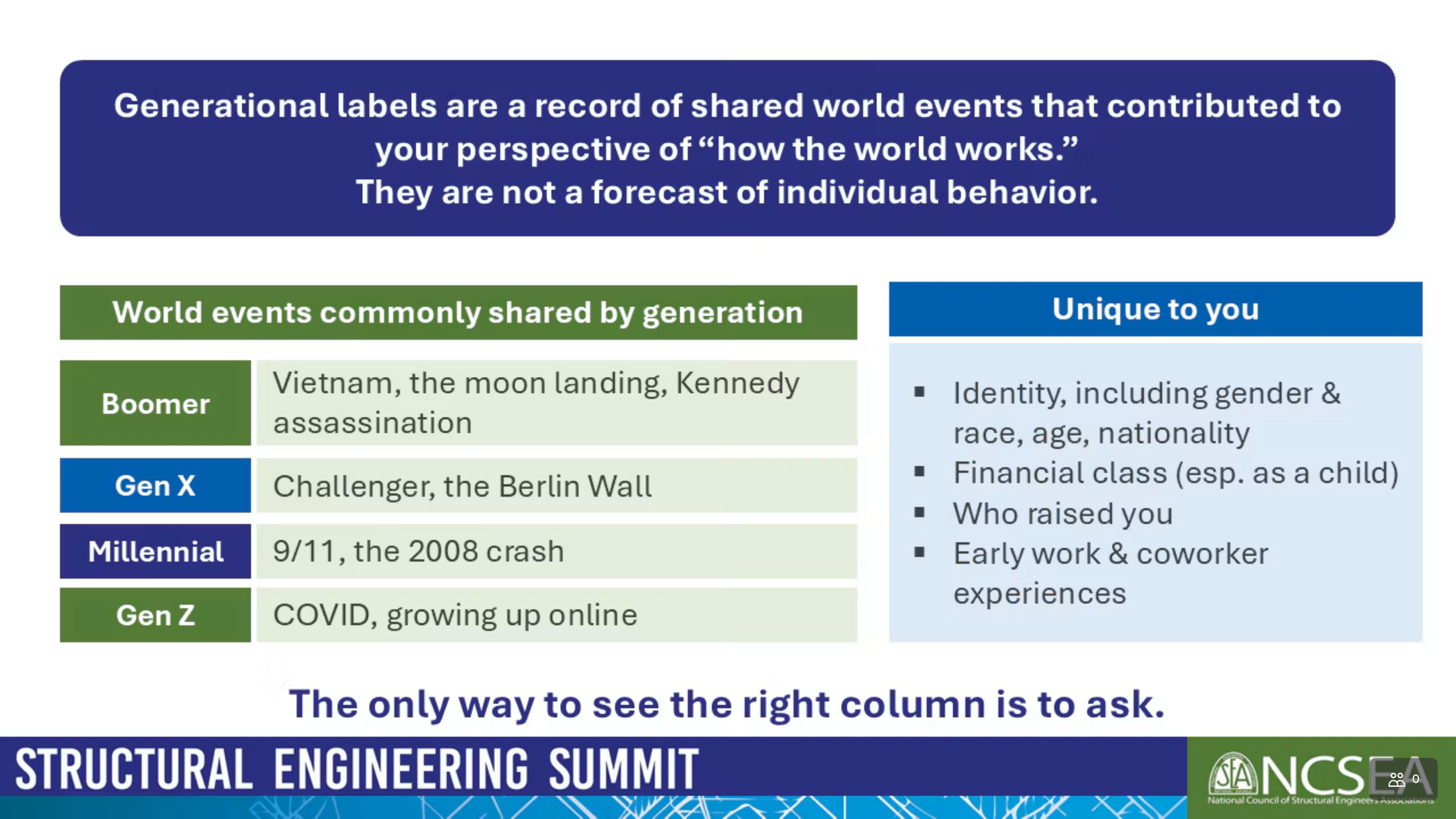
Engineers don’t want to be lumped into a generation; they want to be treated as individual humans, respected for their unique values and skills. The only way to do that is to ask the individual what they want and need, regardless of the generational and other assumptions our brains make based on what someone looks like on the outside.
Generational labels are a record of shared world events that shaped how people see “how the world works.” They are not a forecast of individual behavior.
Connect with the panel
Panelist
David Cocke, SE
Dylan Seesman, PE, NOMA
Megan Vandervort, PE
Stephanie Slocum, PE
Firm
Structural Focus
JQOL
Martin/Martin
Engineers Rising
Contact
dcocke@structuralfocus.com · LinkedIn
dseesman@jqolusa.com · LinkedIn
mvandervort@martinmartin.com · LinkedIn
stephanie@engineersrising.com · LinkedIn · engineersrising.com